Quick Answer
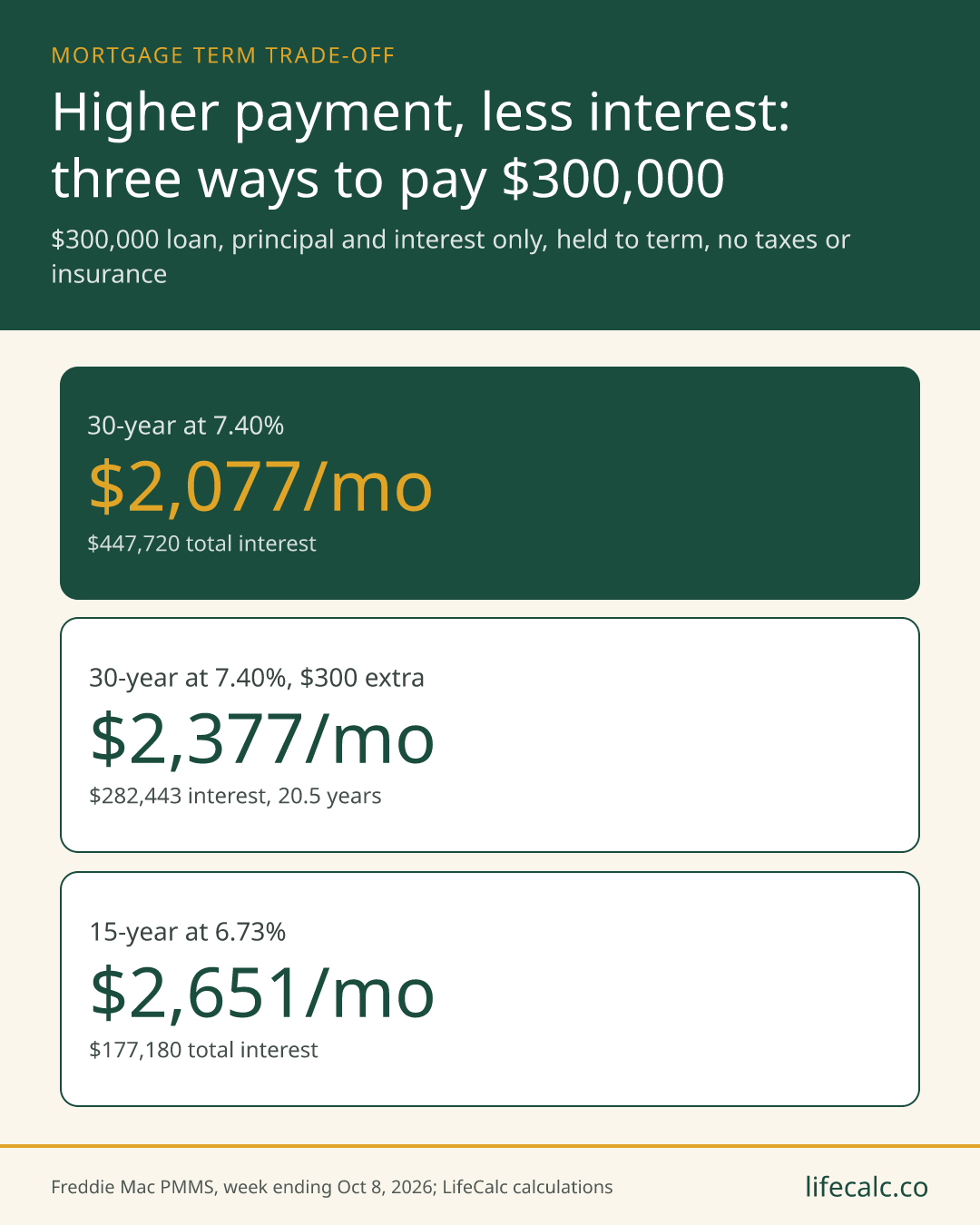
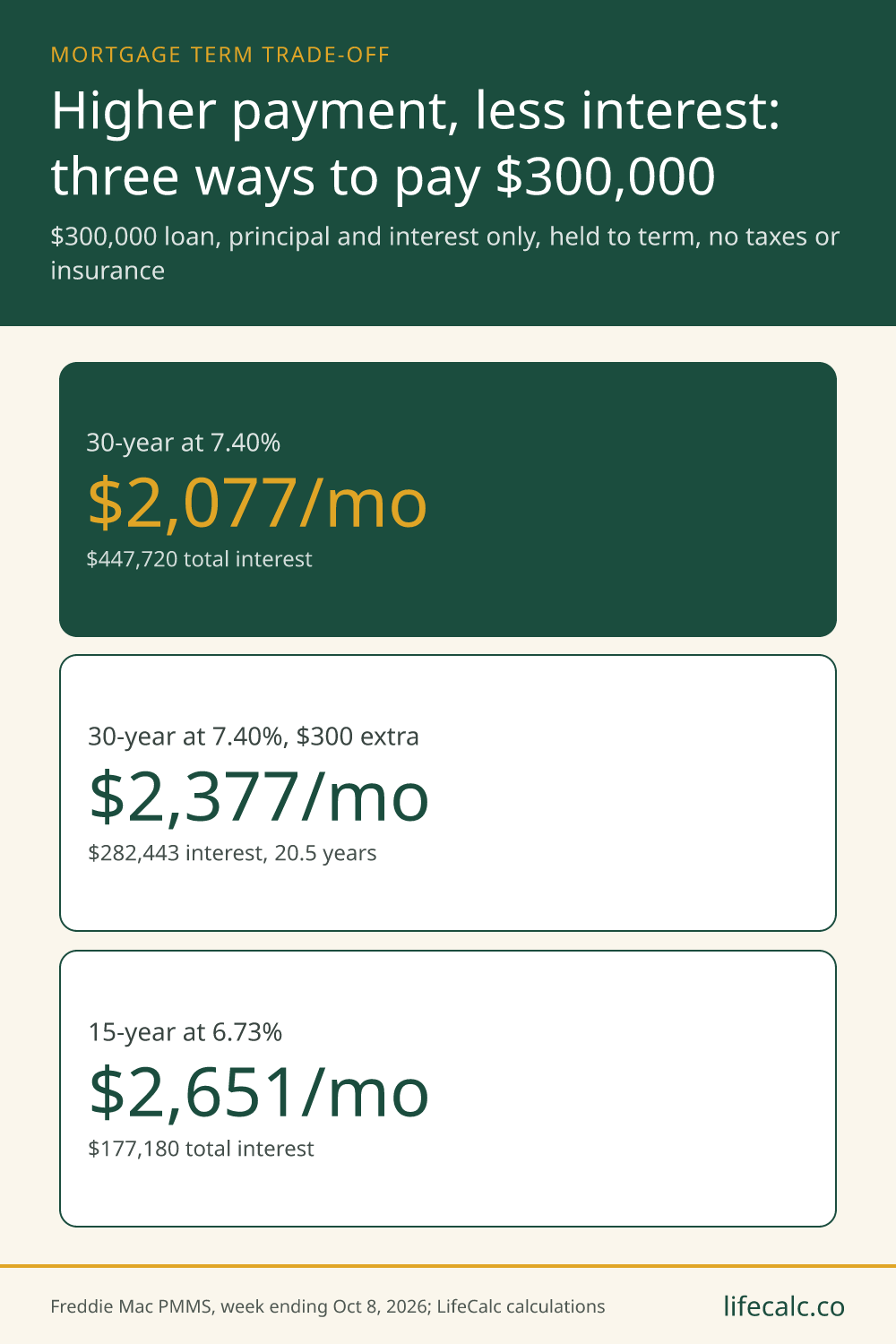
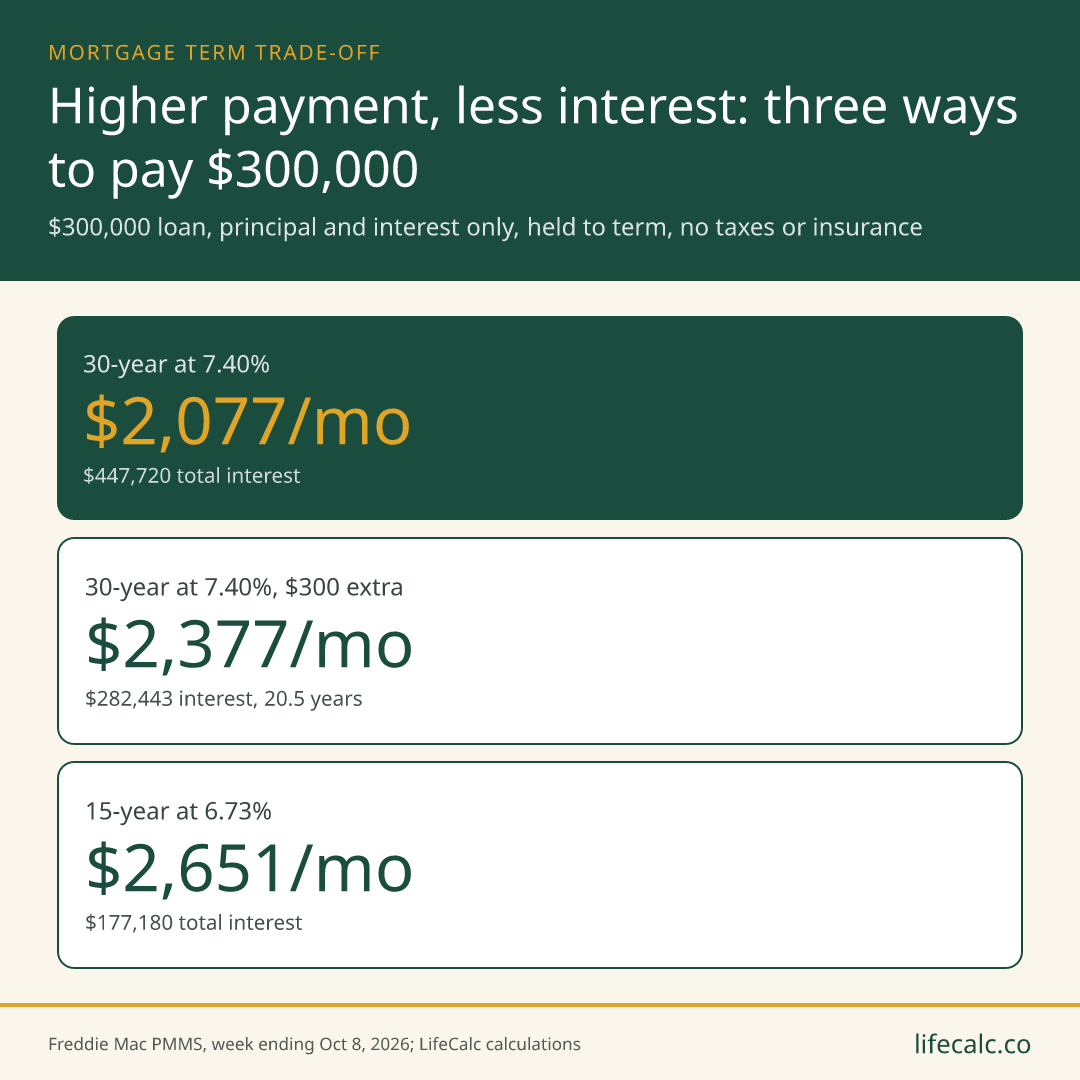
On a $300,000 loan, the 15-year at 6.73% costs $574 more a month than the 30-year at 7.40% and cuts lifetime interest by $270,540. An extra $300 a month on the 30-year saves $165,277 and keeps the option to stop.
Freddie Mac's survey for the week ending Oct 8, 2026 put the 15-year fixed at 6.73% and the 30-year at 7.40%, up from 6.60% and 7.28% the week before. The number that matters for your decision: on a $300,000 loan, the 15-year payment is $574 a month higher and the lifetime interest is $270,540 lower.
All figures below are principal and interest only, on fixed-rate loans held to the end of the term. Property tax, insurance, PMI (private mortgage insurance) and HOA dues come on top.
The 15-year costs $574 more a month and $270,540 less in interest
The 30-year at 7.40% has a payment of $2,077 and total interest of $447,720. The 15-year at 6.73% has a payment of $2,651 and total interest of $177,180. The payment difference is $574 a month, or $6,888 a year.
The last week's rise was small. On the same $300,000, the 30-year payment moved from $2,053 to $2,077, which is $24 a month. The 15-year moved from $2,630 to $2,651, which is $21 a month.
Shorter term does the work: even at 7.40%, the 15-year saves $250,200
To separate the term from the rate, we ran a 15-year loan at the same 7.40% as the 30-year. That payment would be $2,764 with $197,520 of interest, which is $250,200 less interest than the 30-year. The lower 15-year rate of 6.73% adds another $20,340 of savings on top of that.
The 15-year payment needs $113,614 of gross income, against $89,014 for the 30-year
A common guideline keeps principal and interest at or under 28% of gross (before-tax) income. By that rule, the 30-year payment of $2,077 needs about $7,418 a month, or $89,014 a year. The 15-year payment of $2,651 needs $9,468 a month, or $113,614 a year. Lenders also count taxes, insurance and your other debts, so real approval thresholds are tighter than this guideline alone.
An extra $300 a month on the 30-year saves $165,277 and can be stopped
A 30-year loan lets you pay extra principal when you can and fall back to the required payment when you cannot. With $300 extra every month from the first payment, the payment becomes $2,377, the loan is gone in 246 months (20.5 years, or 9.5 years sooner), and interest falls from $447,720 to $282,443. That saves $165,277, assuming no prepayment penalty.
By the same 28% guideline, the $2,377 payment needs $8,489 a month, or $101,871 a year. The required payment, though, stays $2,077, which is the figure a lender tests.
Matching the 15-year payment on a 30-year gets close, but not all the way
If you add $574 a month to the 30-year, the payment is $2,651, the same as the 15-year. The loan pays off in 195 months (16.3 years) with interest of $216,095, which saves $231,625 against the plain 30-year.
| Option on $300,000 | Monthly payment | Total interest | Payoff |
|---|
| 30-year at 7.40% | $2,077 | $447,720 | 30 years |
| 30-year, $300 extra | $2,377 | $282,443 | 20.5 years |
| 30-year, $574 extra | $2,651 | $216,095 | 16.3 years |
| 15-year at 6.73% | $2,651 | $177,180 | 15 years |
Paying the same $2,651 a month, the true 15-year ends sooner and carries less interest because its rate is lower. What the 30-year route gives back is flexibility: the $574 is optional there and required on the 15-year. The $300 version sits $274 a month below the 15-year payment, which is $3,288 a year.
What the numbers point to for each buyer
Stretched first-time buyer. If keeping the required payment low matters more to you than the lowest possible interest, the numbers point to the 30-year, with a modest extra amount you can drop in a tight month. At the 28% guideline, the 15-year needs $113,614 of gross income, while the 30-year needs $89,014.
Higher-income move-up buyer. If $2,651 a month fits comfortably under the guideline, with your other goals still funded, the 15-year gives the lowest interest of the options here: $177,180. If you would rather keep a lower required payment, the extra-payment route above is the alternative.
What would change the answer
- Your income and other debts. The 28% test moves the 15-year in or out of reach.
- Whether you will really pay the extra. The savings from the 30-year path exist only if the extra goes in.
- The rate gap you are quoted. The 15-year's savings come mostly from the shorter term, but a narrower gap between the two quotes would change the payment difference.
Run your own loan
Enter your actual loan size, rate and extra amount in the mortgage calculator. To see what price range fits your income, use the home affordability calculator.