A single worker earning $100,000 keeps $79,180 a year in Texas versus $73,441 in California, a gain of $5,739, because Texas has no state income tax. Fuel is the sharpest price gap right now: AAA puts California regular at $6.30 a gallon, the highest in the nation, against $3.82 in Texas, with a national average of $4.36.
Cost of Living
California to Texas on $100,000: take-home, gas and a 10% pay cut
By Frank SterlingPublished
Moving from California to Texas on $100,000 adds $5,739 in take-home. See whether a 10% pay cut holds up once gas at $6.30 vs $3.82 counts.
Quick Answer
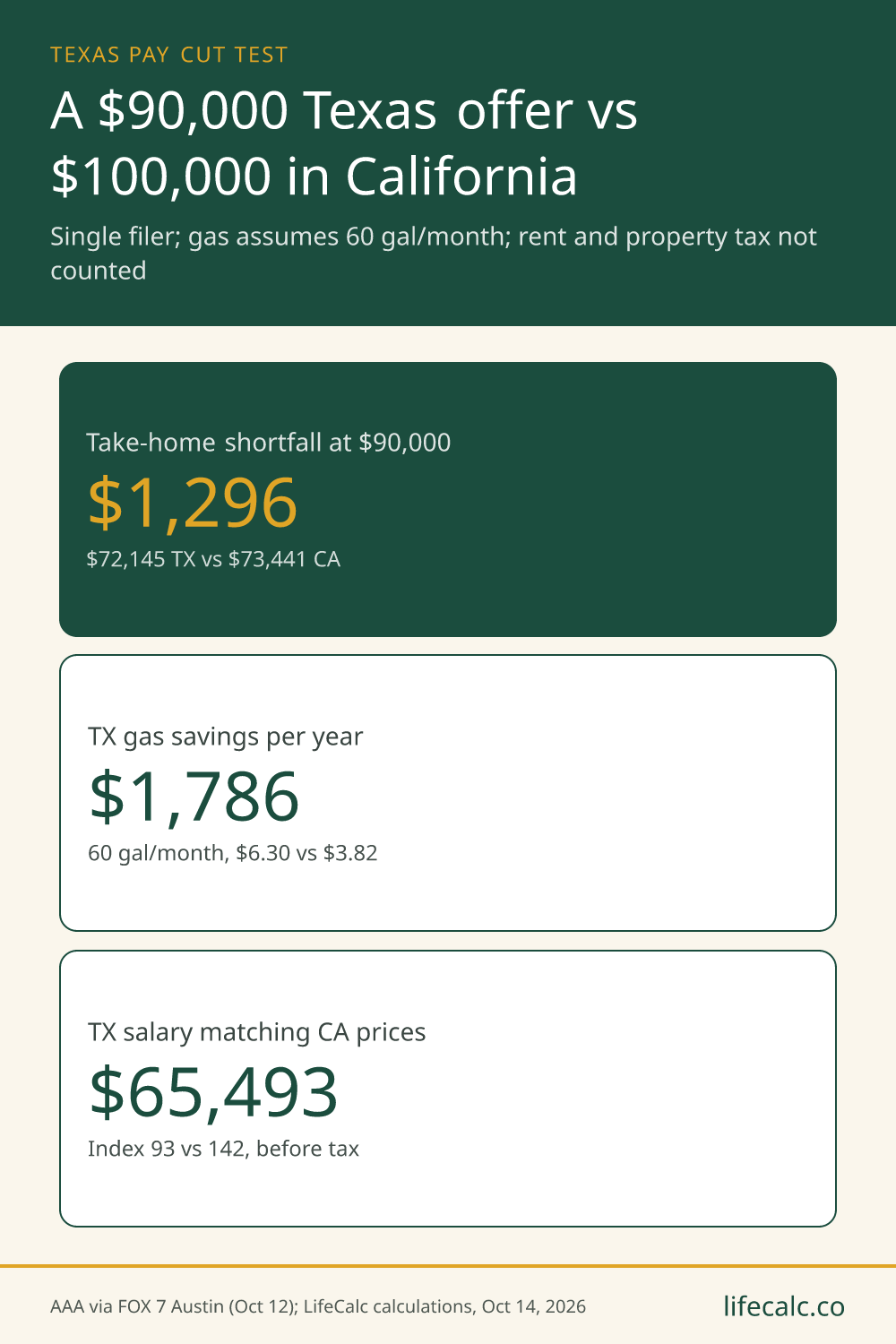
A single worker keeps $5,739 more of a $100,000 salary in Texas, and a 10% cut to $90,000 leaves take-home $1,296 lower than California. If a household burns 60 gallons of gas a month, the $6.30 vs $3.82 price gap is worth $1,786 a year, which would cover that shortfall, but fewer gallons shrink the margin.
These figures use 2026 federal income tax, Social Security and Medicare (FICA) and state income tax, with the standard deduction and no other deductions or credits. Local, sales and property taxes are not included.
| Scenario | California take-home | Texas take-home | Difference |
|---|---|---|---|
| Single, $100,000 | $73,441 | $79,180 | $5,739 |
| Married, $140,000 combined | $106,691 | $116,150 | $9,459 |
For the single worker that is $478 more a month ($6,598 versus $6,120). For the married couple it is $788 more a month ($9,679 versus $8,891).
A statewide index puts the matching Texas salary at $65,493
A cost-of-living index scales overall prices against a U.S. average of 100. California scores 142 and Texas 93. On that measure, $100,000 in California buys what $65,493 buys in Texas, a gap of $34,507. For the couple, $140,000 matches $91,690, a gap of $48,310.
This is one statewide average, and it does not describe any single household. City pairs differ: Los Angeles to Dallas gives an equivalent of $62,651, and San Francisco to Austin gives $62,570. The index measures price levels, so it works on salary before tax. The take-home table above measures tax. They are two views of the same move, not two separate gains to add together, and this article does not calculate a single combined figure.
Gas at $6.30 vs $3.82 is worth $1,786 a year on 60 gallons a month
Try the Calculator
Compare take-home in each state →The 60 gallons a month is an assumption for this example, not a sourced typical figure. Assume the household drives the same amount after the move. In California that is $378 a month, or $4,536 a year. In Texas it is $229.2 a month, or $2,750 a year. The difference is $149 a month, or $1,786 a year, and California fuel costs 64.9% more for the same 60 gallons.
Gas is also one line inside the price levels the index already averages, so treat the $1,786 as a closer look at one expense, not an extra benefit stacked on the index. Separately, gasoline prices are up 34.2% over 12 months in the BLS Consumer Price Index. That is a national figure. It does not show whether the California-Texas gap itself changed, so the $1,786 rests only on today's $6.30 and $3.82.
A 10% cut to $90,000 lowers take-home by $1,296, and 60 gallons of gas covers it
Say a Texas employer offers a remote worker $90,000 instead of $100,000. Texas take-home on $90,000 is $72,145 a year, or $6,012 a month, after $17,855 in total tax (an effective rate of 19.8%). That is $1,296 below the $73,441 the same person keeps in California on $100,000, or $108 a month.
| Item | Annual figure |
|---|---|
| California take-home on $100,000 | $73,441 |
| Texas take-home on $90,000 | $72,145 |
| Take-home shortfall | $1,296 |
| Gas savings in Texas (60 gallons a month) | $1,786 |
| Gas savings left after the shortfall | $490 |
The numbers support a conditional answer. If the household burns about 60 gallons a month, the gas gap alone exceeds the take-home shortfall, with $490 to spare. That margin is thin and disappears with fewer gallons. If your other costs also fall toward the Texas index of 93, the offer has more room than that, since $90,000 is above the $65,493 index match. If your rent or insurance would not fall, the $1,296 is the number to weigh. For comparison, a Texas job at full pay would take home $79,180, which is $7,035 more than on $90,000.
What would change the answer
Try the Calculator
Find your equivalent salary →- Gallons burned. The $490 margin depends on 60 gallons a month. Fewer gallons shrink it.
- Your costs versus the index. Rent, insurance and your spending mix could land above or below the 93 and 142 averages. Property and sales taxes are not in the take-home numbers.
- Filing status and income. The couple at $140,000 gains $9,459 in take-home, against $5,739 for the single worker, and could accept about $91,690 on the index. A second earner, deductions or credits change your own figure.
How to run it for your own situation
Enter your salary and filing status in the paycheck calculator to see take-home in each state. Use the cost-of-living calculator to test the equivalent salary for your two cities, and the job offer tool to compare a Texas offer with your current pay. For gas, replace 60 gallons with your own monthly figure and use the $6.30 and $3.82 prices.
Try the Calculator
Weigh a job offer →How we calculated this
- Cost-of-living index where the U.S. average is 100; it scales overall prices and does not capture any one household's spending.
- Federal income tax, FICA and state income tax for the 2026 tax year, standard deduction, no other deductions or credits; local, sales and property taxes are not included.
Sources
- FOX 7 Austin (citing AAA, Oct 12), 2026-10-12: AAA: California regular gasoline averages $6.30 a gallon, the highest in the nation, versus $3.82 in Texas; national average $4.36.
- BLS Consumer Price Index news release, 2026-10-14: Gasoline CPI is up 34.2% over 12 months, which makes the state fuel gap matter more.
Related Calculators
Related Articles
Cost of Living in California 2026: What a Single Person NeedsCalifornia costs 42% above the U.S. average. City-by-city rent, taxes and the salary a single person needs, computed from LifeCalc data.Indiana Cost of Living GuideA detailed guide to Indiana's cost of living in 2026, including housing, taxes, city comparisons, and why remote workers are choosing Indiana over coastal states.Cost of Living in Texas 2026Texas cost of living by city, property tax reality, no income tax savings, and who benefits most from living in Texas.Cost of Living in Florida 2026: Taxes, Metros, InsuranceFlorida costs 3% above average with no income tax. We compute what that saves vs NC, GA, NY and CA, by metro, plus an insurance break-even test.Dallas vs Houston Cost of Living 2026Dallas COL is 104 vs Houston at 96. Compare housing, jobs, taxes, and lifestyle in Texas two biggest metros.