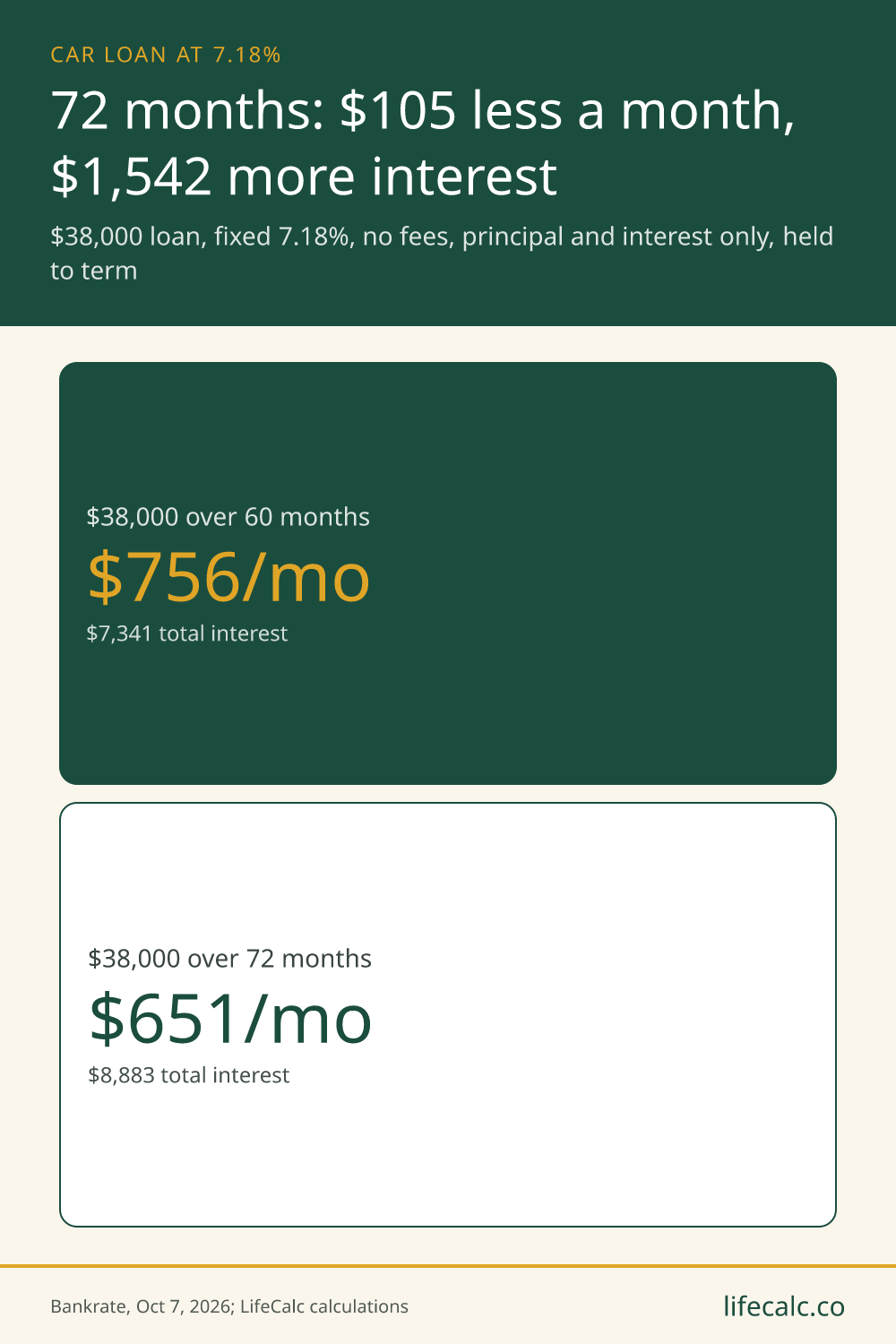
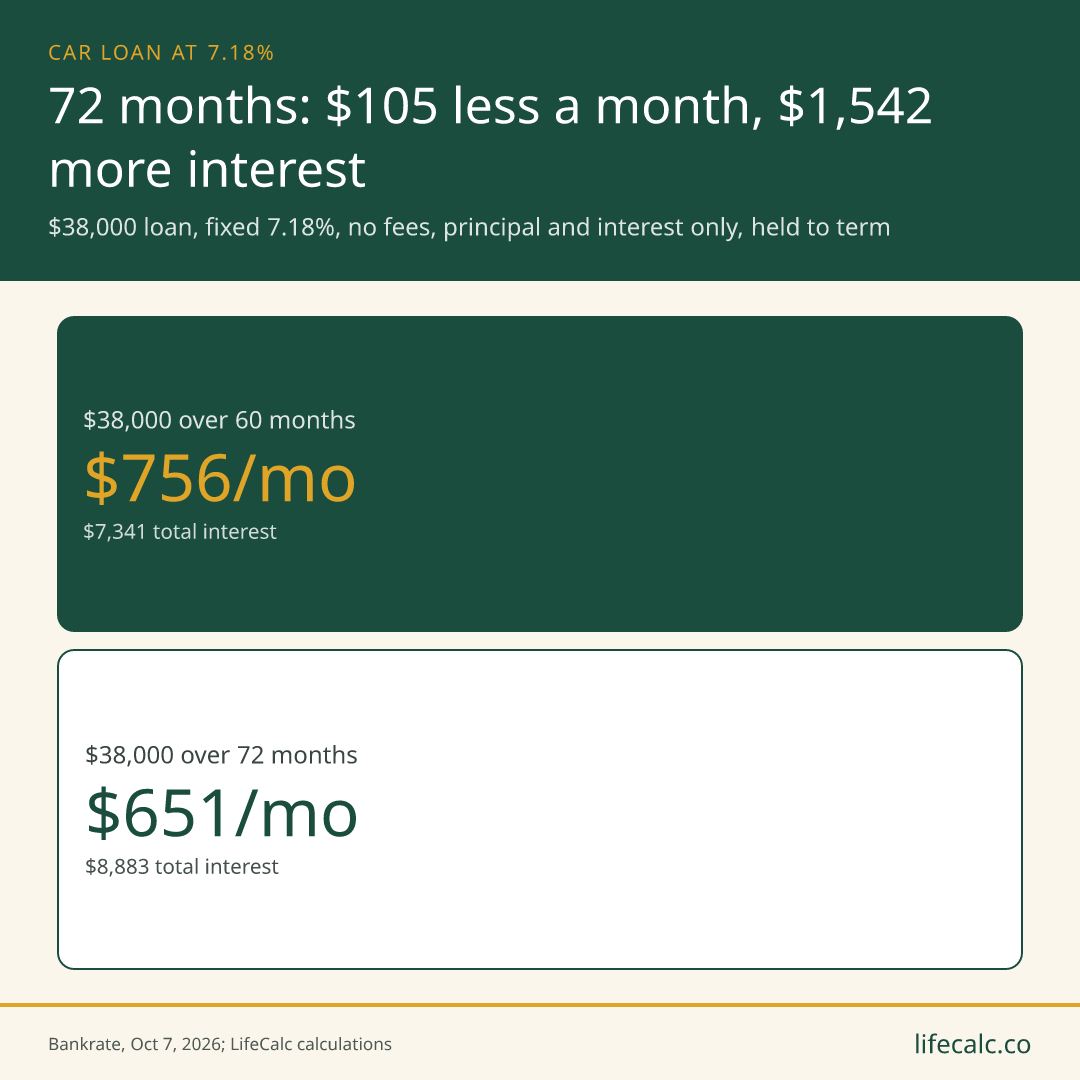
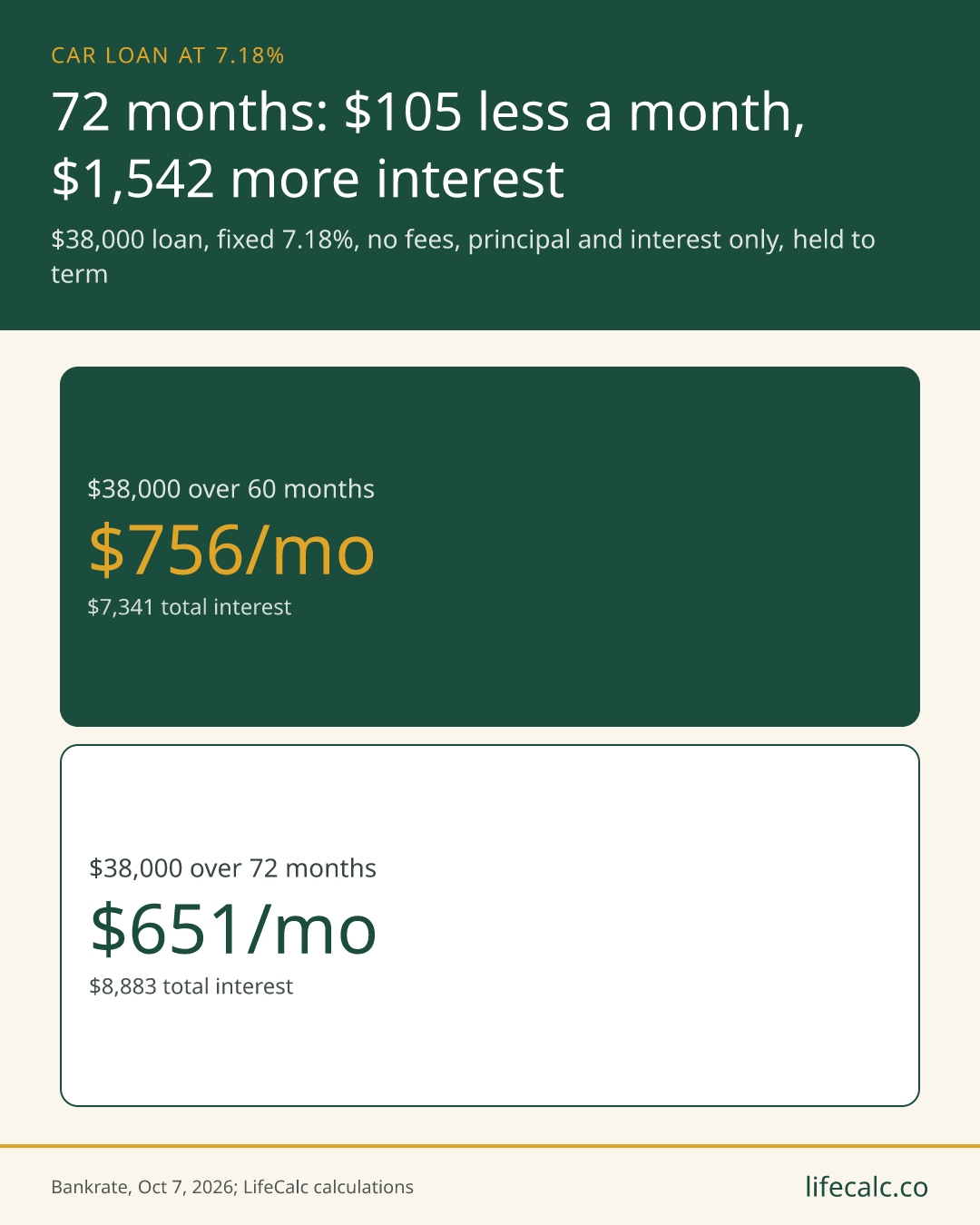
Bankrate's weekly survey put the average 60-month new car loan rate at 7.18% on October 7. At that rate, the choice that moves your cost most between the options below is the loan term: stretching a $38,000 loan from 60 to 72 months drops the payment by $105 a month and adds $1,542 in interest.
Debt
Car loan at 7.18%: what $38,000 costs over 60 vs 72 months
By Frank SterlingPublished
At Bankrate's 7.18% average, a $38,000 car loan costs $756 a month over 60 months or $651 over 72, with $1,542 more interest. See the numbers.
Quick Answer
At 7.18%, stretching a $38,000 car loan from 60 to 72 months cuts the payment from $756 to $651 but adds $1,542 in interest. A $30,000 car at 60 months costs $597 a month and $5,795 in interest, lower on both counts than the $38,000 car at 72 months.
Every figure below assumes a fixed 7.18% rate for both terms, equal monthly payments, no fees and a loan held to the end of its term. Interest is the extra you pay the lender on top of the amount borrowed.
| Loan | Term | Monthly payment | Total interest | Total paid |
|---|---|---|---|---|
| $30,000 | 60 months | $597 | $5,795 | $35,795 |
| $30,000 | 72 months | $514 | $7,013 | $37,013 |
| $38,000 | 60 months | $756 | $7,341 | $45,341 |
| $38,000 | 72 months | $651 | $8,883 | $46,883 |
Stretching $38,000 to 72 months saves $105 a month and costs $1,542
The 60-month payment of $756 is 16.1% higher than the 72-month payment of $651. In return, the 72-month loan carries $8,883 in interest against $7,341 on the shorter loan, which is 21% more.
The same pattern holds on the smaller loan. Going from 60 to 72 months on $30,000 lowers the payment from $597 to $514, an $83 difference, and raises interest from $5,795 to $7,013, which is $1,218 more.
If fitting the monthly payment into your budget matters more to you than total cost, the longer term does that. The table shows what you pay for it.
A 1-point lower rate saves $18 a month; 12 extra months adds $1,542
Try the Calculator
Run your own car loan numbers →Suppose a better credit score earns a rate one point lower. On the $38,000, 60-month loan at 6.18% instead of 7.18%, the payment is $738 instead of $756, and interest is $6,270 instead of $7,341, a $1,071 difference.
Side by side: the lower rate cuts the payment by $18 a month, while the longer term cuts it by $105. But the longer term adds $1,542 in interest at 7.18%, which is more than the $1,071 the lower rate removes. If the goal is lowest total interest, the numbers point to the shorter term and the better rate together.
Paying $756 on the 72-month loan lands near the 60-month cost
You can take the 72-month loan and still pay $756, which is $105 extra a month applied to principal from the first payment. On the $38,000 loan at 7.18%, it is paid off in 60 months and interest is $7,337. Paying only the scheduled $651 gives $8,872 in interest on this schedule, so the extra payments save $1,535.
Notice that $7,337 is almost exactly the $7,341 on the plain 60-month loan. The extra payment does not beat a 60-month loan. What it buys is the option to drop back to $651 in a tight month, which a 60-month contract does not give you. This assumes the lender charges no prepayment penalty, so check the contract.
When the cheaper car wins: $30,000 at 60 months beats $38,000 at 72
Try the Calculator
Check the payment against your budget →Compare the $30,000 loan at 60 months with the $38,000 loan at 72 months. The cheaper car has the lower payment ($597 against $651, which is $54 less), the lower interest ($5,795 against $8,883) and the lower total paid ($35,795 against $46,883). It wins on every line, even though it uses the shorter term.
Matching the term is a different comparison. The $38,000 car at 60 months costs $159 more a month than the $30,000 car at 60 months ($756 against $597). If the extra car is worth that to you, the numbers support it.
What income a $756 payment needs, and what else the car costs
For a rough test, this article assumes the loan payment, principal and interest only, should stay at or under 10% of gross income. That ratio is a rule of thumb we chose for illustration, not a lender requirement, and a stricter or looser ratio changes the answer. On that assumption, a $756 payment needs a gross income of $90,720 a year, or $7,560 a month. Lenders also look at insurance, taxes and your other debts.
The payment is also not the whole monthly cost of the car. The BLS reports gasoline CPI up 34.2% over 12 months, so fuel takes more of a budget than it did a year ago. We have no verified figure for your own fuel bill, but whatever it is, it sits on top of the payment you pick.
What would change the answer
- The term. Twelve months adds $1,542 in interest on $38,000 and $1,218 on $30,000.
- The rate. One point lower saves $18 a month and $1,071 in interest on the 60-month $38,000 loan.
- The price. Going from $38,000 to $30,000 at 60 months lowers the payment by $159 a month.
- Prepayment terms. The $1,535 saving needs a loan with no penalty for paying early.
To test your own price, rate and term, use the auto loan calculator. To see whether the payment fits beside your other bills, run it through the budget calculator.
How we calculated this
- Fixed rate, equal monthly payments, no fees.
- Fixed rate; the extra amount goes to principal every month from the first payment; no prepayment penalty.
- Uses the common guideline that principal and interest stay at or under 10% of gross income; lenders also count taxes, insurance and other debts.
Sources
- Bankrate, 2026-10-07: Bankrate's weekly survey shows the average 60-month new car loan rate at 7.18%.
- BLS Consumer Price Index news release, 2026-10-14: Gasoline CPI is up 34.2% over 12 months, raising running costs.
Related Calculators
Related Articles
Student Loan Repayment: SAVE Plan Ending 2026The SAVE plan was eliminated. Here are your remaining repayment options, how to calculate payments, and what to do now.Is Debt Consolidation Worth It?Debt consolidation can save money or cost more. Learn when it works, when it doesn't, and compare balance transfers vs personal loans.Pay Off Debt or Invest: Which Comes First?Should you pay off debt or invest? Compare interest rates, guaranteed returns, and the optimal strategy for both.The Credit Card Minimum Payment TrapPaying the minimum on credit cards costs thousands in interest. See how a $5K balance takes 7+ years to pay off and how to escape.How to Pay Off Credit Card Debt FastThe average American carries $6,500 in credit card debt at 22% APR. Here are proven strategies to eliminate it and the math behind each.