Quick Answer
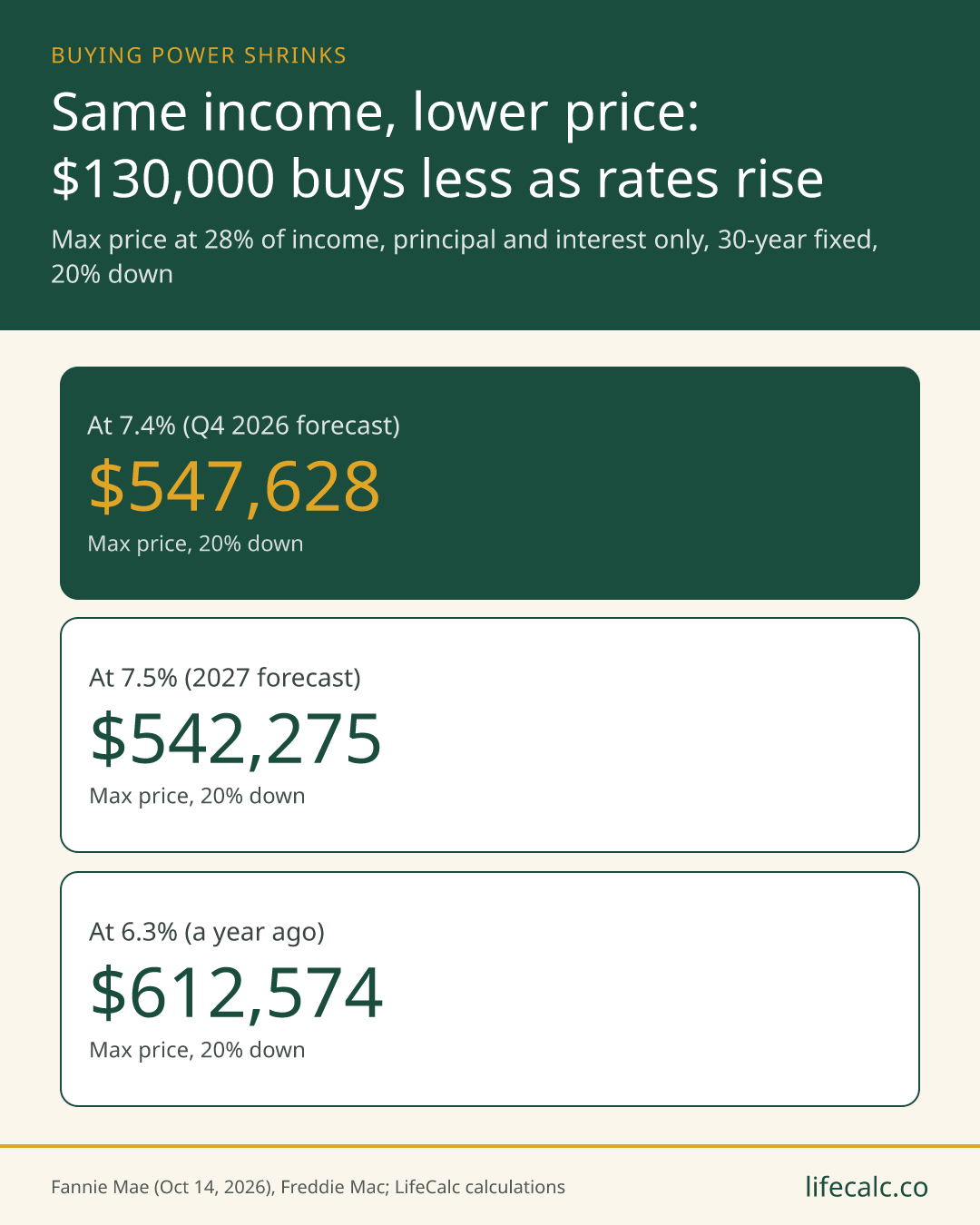
At 7.4% with 20% down, a couple earning $130,000 tops out at a $547,628 home on the 28% guideline, versus $612,574 at 6.3% a year ago. Fannie Mae forecasts 7.5% through 2027, so waiting for cheaper borrowing runs against that forecast.
Fannie Mae's October outlook, published Oct 14, forecasts the 30-year fixed mortgage rate at 7.4% in Q4 2026 and 7.5% in each quarter of 2027, up from 6.8% and 6.7% in its September forecast. For a couple earning $130,000, 7.4% with 20% down caps the price at $547,628 on the 28% guideline, against $612,574 at 6.3% a year ago.
The couple, the income and the $450,000 home in this article are illustrations, not a prediction for your situation. Every figure assumes a 30-year fixed loan and that principal and interest (the loan payment before taxes and insurance) stay at or under 28% of gross income. On $130,000 that is a monthly budget of $3,033. Property tax, homeowners insurance and other debts would lower every price shown. So would PMI (private mortgage insurance), which lenders can require when the down payment is under 20%, so the 10%-down figures are the most generous version.
The forecast moved up, and the current rate is already high
Two separate sources matter here. Freddie Mac's weekly survey put the 30-year fixed at 7.40% as of Oct 8, against 6.30% a year earlier. That is what borrowers were seeing in the survey. Fannie Mae's figures are a forecast: 7.4% for Q4 2026 and 7.5% for each 2027 quarter. The forecast does not show a dip.
At $130,000, the 28% budget buys $482,022 to $547,628 at forecast rates
The price depends on the rate and on the down payment. A bigger down payment lets the same $3,033 payment support a higher price.
| Rate | Max price, 10% down | Max price, 20% down |
|---|
| 6.3% (a year ago) | $544,510 | $612,574 |
| 7.4% (Q4 2026 forecast) | $486,781 | $547,628 |
| 7.5% (2027 forecast) | $482,022 | $542,275 |
Compare the two down payments at the same rate. At 7.4%, the maximum loan is $438,103 either way, because the payment budget is the same. With 10% down, that loan goes with a $48,678 down payment and a $486,781 home. With 20% down, it goes with a $109,526 down payment and a $547,628 home. The higher price comes from the extra cash you bring, not from borrowing more.
A year of higher rates cut this couple's price by $64,946 at 20% down
Hold the down payment at 20% and the income at $130,000. At 6.3% the 28% budget supported $612,574. At 7.4% it supports $547,628, a difference of $64,946. Put the other way, the 6.3% price was 11.9% higher. Their income did not change in this comparison. Only the rate did.
A $450,000 home costs $325 more a month at 7.5% than at 6.3%
Take a $450,000 home with 10% down, a $405,000 loan, and principal and interest only. No PMI, tax or insurance is included.
| Rate | Monthly payment | Gross income needed at 28% |
|---|
| 6.3% | $2,507 | $107,443 |
| 7.5% | $2,832 | $121,371 |
That is $325 more a month, $3,900 a year, and $117,000 more interest if the loan is held to its full term. At 7.4% the same loan is $2,804 a month.
The couple's $3,033 budget covers the $2,832 payment with $201 to spare. That $201 would have to absorb property tax, insurance and PMI, so a $450,000 home at 7.5% with 10% down sits close to the edge of the guideline, and could land over it once those costs are added.
Stretch, buy smaller, or wait: what the numbers show
- Stretch. Going above the table prices means a payment over 28% of income. If a larger home matters more to you than a looser monthly budget, the numbers show what you give up: room for taxes, insurance, PMI and other debts.
- Buy smaller or put more down. With 20% down on $450,000 at 7.5%, the loan is $360,000 and the payment is $2,517, with $90,000 down. The same home with 10% down is $2,832 a month before PMI. If a lower payment matters more to you than keeping cash in the bank, more down does that.
- Wait. Waiting for a lower rate runs against Fannie Mae's path of 7.4% and then 7.5%, though forecasts can miss in either direction. The rate is also only one input. Home prices could move, your savings could grow, and your job, family plans or rent could change. If the reason to wait is to build a bigger down payment, the table shows what 20% down supports compared with 10%.
What would change the answer
- The rate. On the $450,000 example, the move from 6.3% to 7.5% adds $325 a month.
- The down payment. At 7.4%, 20% down supports $547,628 and 10% down supports $486,781.
- Taxes, insurance, PMI and other debts. None of the prices above include them, so each one lowers the price.
A decision rule for your own numbers
Multiply gross income by 28% and divide by 12 for the monthly budget. Then subtract your estimated property tax, insurance and PMI before you look at prices. What is left is the principal and interest you can carry. Our home affordability calculator runs this with your income, rate and down payment, and the mortgage calculator shows the payment on a specific home. To see whether renting changes the picture, use rent vs buy. Our methodology page explains how the figures here are calculated.