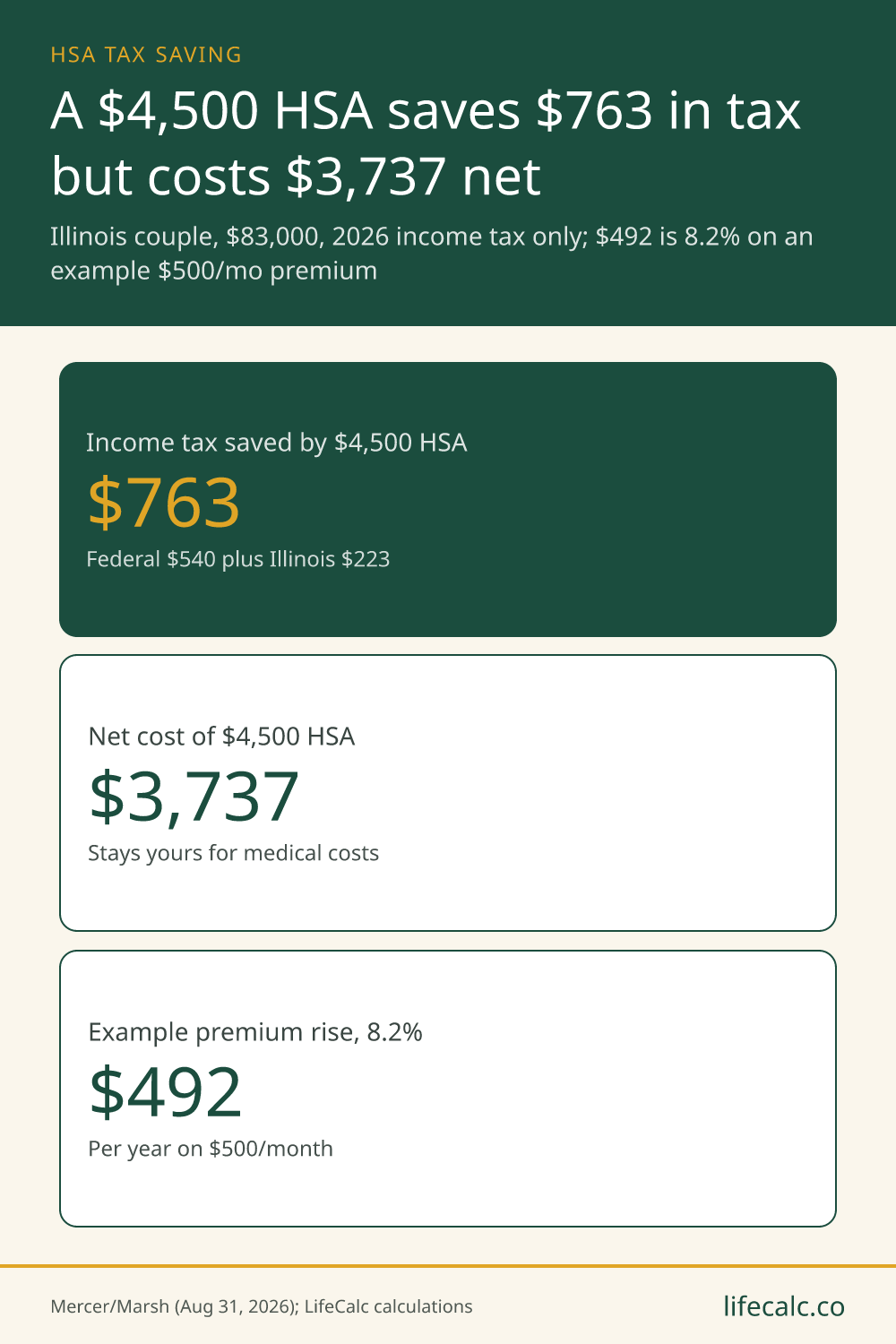
Marsh projects total health benefit cost per employee to rise 8.2% in 2027, the largest rise since 2003 (about 11% without cost-cutting). Applied to a $500/month premium as an illustration, 8.2% is $41 more a month, or $492 a year.
Budget
Illinois take-home and an 8.2% health cost rise: what an HSA saves
By Frank SterlingPublished
Three Illinois households, $75,000 to $150,000: take-home pay, what an 8.2% health cost rise could mean, and what a pre-tax HSA saves in tax.
Quick Answer
Marsh projects employer health benefit cost per employee up 8.2% in 2027, and a pre-tax $4,500 HSA contribution saves the $83,000 Illinois couple $763 in income tax, at a net cost of $3,737 put into the account. That saving is a discount on money you choose to set aside for medical costs, not an offset to a premium increase.
The 8.2% covers the whole cost per employee, employer and worker shares together. Your own deduction could rise by more or less. The same survey found that about two-thirds of large employers (500+) expect to raise employees' share of premiums, and 59% plan cost-cutting changes such as higher deductibles. So $500 a month rising to $541 is a worked example, not a forecast of your bill.
A health savings account (HSA) also requires a high-deductible health plan, and that plan can carry a different premium than the $500 used here. If you are weighing an HSA-eligible plan, use that plan's own premium and deductible in place of these figures.
What three Illinois households take home: $57,879, $66,941 and $115,760
These figures use 2026 federal income tax, Social Security and Medicare tax (FICA) and Illinois income tax, with the standard deduction and no other deductions or credits. Local, sales and property taxes are left out. Open enrollment is for 2027, and 2027 brackets and the standard deduction may differ, so treat the dollar amounts as a close guide rather than your 2027 result. The $75,000 earner files as single. The other two are married, and the $150,000 household is a dual-income couple with $150,000 combined. Illinois's median household income in the LifeCalc dataset is $83,211, so the $83,000 couple sits at the median.
| Household | Take-home a year | Per month | Effective tax rate |
|---|---|---|---|
| Single, $75,000 | $57,879 | $4,823 | 22.8% |
| Married, $83,000 | $66,941 | $5,578 | 19.3% |
| Married, $150,000 | $115,760 | $9,647 | 22.8% |
A $500/month premium is $6,000 a year, and after an 8.2% rise it is $6,492. That is 11.2% of the single earner's take-home and 9.7% of the $83,000 couple's. This treats the premium as paid from after-tax pay. Many employer premiums come out before tax, which would make the share of take-home somewhat smaller. Run your own salary through the paycheck calculator to see your figures.
A $4,500 HSA saves the $83,000 couple $763 in income tax
Try the Calculator
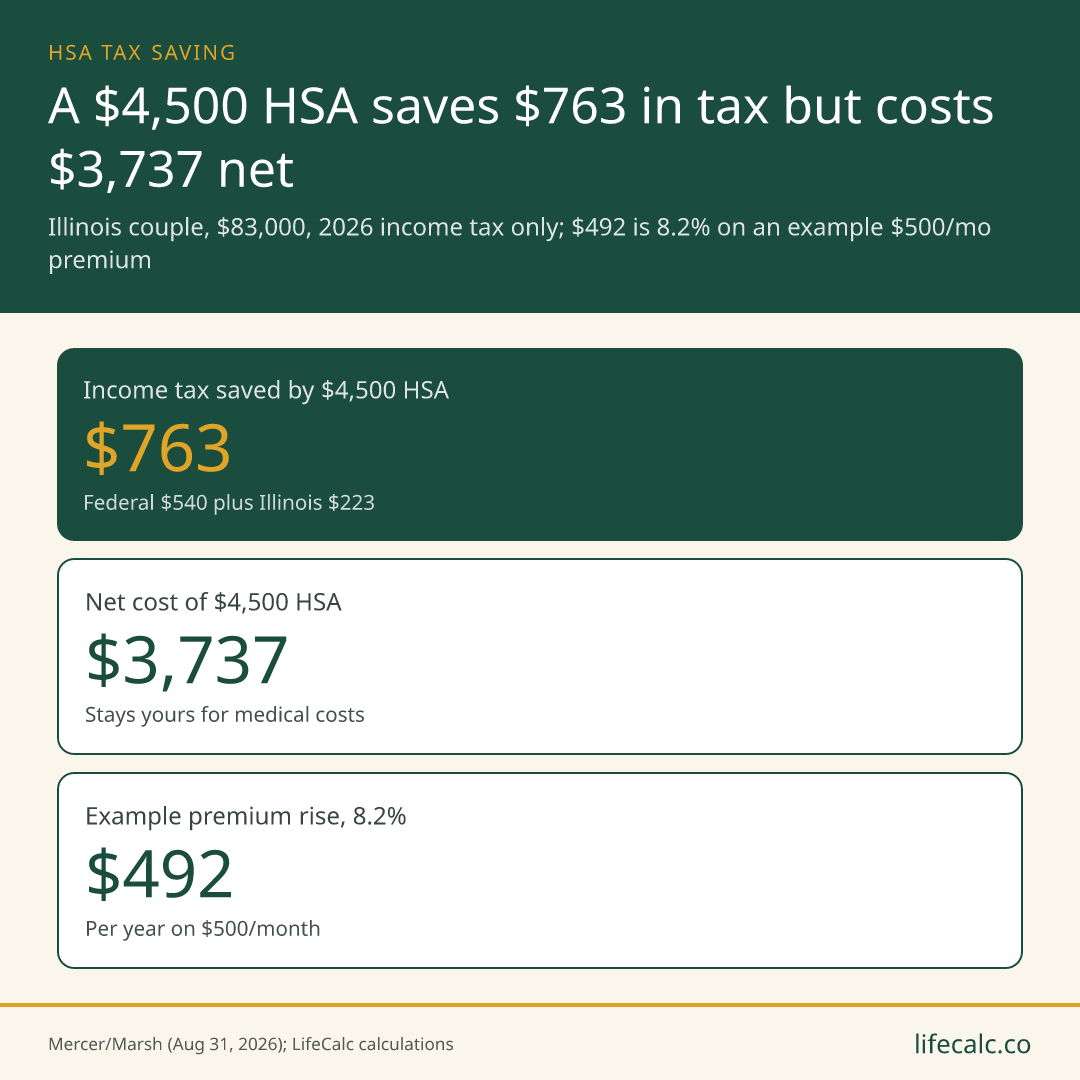
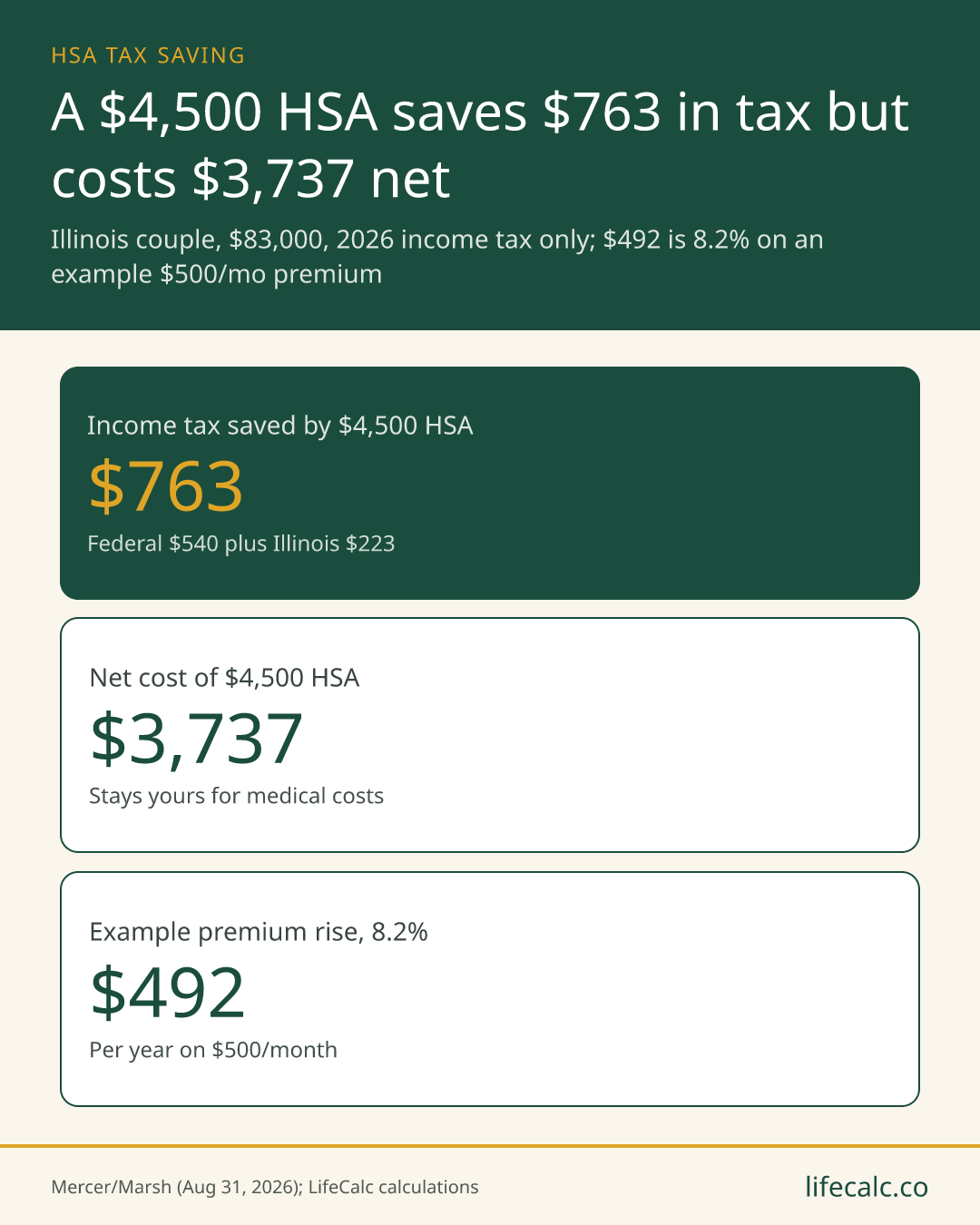
Run your take-home pay →Contributions made through your paycheck lower your taxable income. For the $83,000 couple, $4,500 saves $540 in federal tax and $223 in Illinois tax, $763 in all. The net cost of that contribution is $3,737.
That $763 should not be read against the $492. The $492 is a cost you may be handed. The $3,737 is money you move into your own account by choice, and it only pays off if you spend it on medical costs. The tax saving makes each dollar you set aside cheaper. It does not cancel a premium increase. These savings count income tax only. FICA savings, which can apply to HSA payroll contributions, are not included.
Doubling to $9,000 roughly doubles the tax saved, and the net cost
The $4,500 and $9,000 amounts are illustrations, not IRS limits. No limit is in the verified figures here, and limits differ for self-only and family coverage, so confirm the current ones with your plan or the IRS before you elect.
| Household | Contribution | Income tax saved | Net cost |
|---|---|---|---|
| Single, $75,000 | $4,500 | $1,213 | $3,287 |
| Married, $83,000 | $4,500 | $763 | $3,737 |
| Married, $83,000 | $9,000 | $1,526 | $7,474 |
| Married, $150,000 | $4,500 | $1,213 | $3,287 |
| Married, $150,000 | $9,000 | $2,425 | $6,575 |
At $83,000, going from $4,500 to $9,000 moves the tax saved from $763 to $1,526 and the net cost from $3,737 to $7,474. At $150,000 the $9,000 contribution saves $2,425 and costs $6,575 net.
A rule for what to set aside at open enrollment
Try the Calculator
Estimate your income tax →- Confirm eligibility first. Without a qualifying high-deductible plan, none of the savings above apply.
- Find your likely medical spending. Start from the plan's deductible and the costs you expect, not from the tax saving.
- Set the contribution near that spending if the monthly cash flow allows. The net costs in the table, from $3,287 to $7,474, come out of take-home of $4,823 to $9,647 a month, so check the deduction against your fixed bills first.
- Stay under the IRS limit for your coverage type. Confirm it before you elect.
If you would rather keep cash free for rent and groceries than prepay medical costs, the numbers point to a smaller contribution, since every dollar still lowers taxable income by that dollar. If you expect to hit your deductible anyway, a larger contribution turns costs you would pay anyway into pre-tax dollars.
What would change this
- Your actual premium. If your employer shifts more than 8.2% to you, the increase is larger than $492. If your HSA-eligible plan has a different premium, it may differ either way.
- Your deductible. With 59% of employers planning changes such as higher deductibles, what you owe before insurance pays may matter as much as the premium.
- Your tax situation. The same $4,500 saves $1,213 for the single earner and $763 for the $83,000 couple.
- 2027 tax rules. These figures use 2026 rules.
To test a deduction against your monthly spending, use the budget calculator, and for your own tax picture, the tax calculator. Method notes are on the methodology page.
Try the Calculator
Fit a deduction into your budget →How we calculated this
- Cost-of-living index where the U.S. average is 100; it scales overall prices and does not capture any one household's spending.
- State figures are from the LifeCalc dataset described on the methodology page.
- Federal income tax, FICA and state income tax for the 2026 tax year, standard deduction, no other deductions or credits; local, sales and property taxes are not included.
- Applies the percentage change to the whole amount.
- Contribution lowers federal and state taxable income; FICA savings (which apply to HSA/FSA payroll contributions but not 401(k)) are not counted. A few states tax some of these contributions.
Sources
- Mercer/Marsh, 2026-08-31: Marsh projects total health benefit cost per employee to rise 8.2% in 2027, the largest rise since 2003 (about 11% without cost-cutting)
Related Articles
What Is a Good Net Worth by Age?Median net worth by age from Fed data, how to calculate yours, and what the benchmarks actually mean for your finances.The 50/30/20 Budget Rule: Complete GuideHow to use the 50/30/20 budget rule with real examples. What counts as needs, wants, and savings at every income.How Much Car Can I Afford?Use the 20/4/10 rule to find out how much car you can afford. True cost of ownership, new vs used, and budget math.How Tariffs Are Raising Your Cost of LivingNew tariffs on China, Canada, Mexico, and the EU are increasing consumer prices across categories. See the estimated impact on your household.How to Budget on a $50K SalaryA $50K salary gives you roughly $3,200/month after taxes. Here is a detailed 50/30/20 breakdown with city-specific adjustments.