Quick Answer
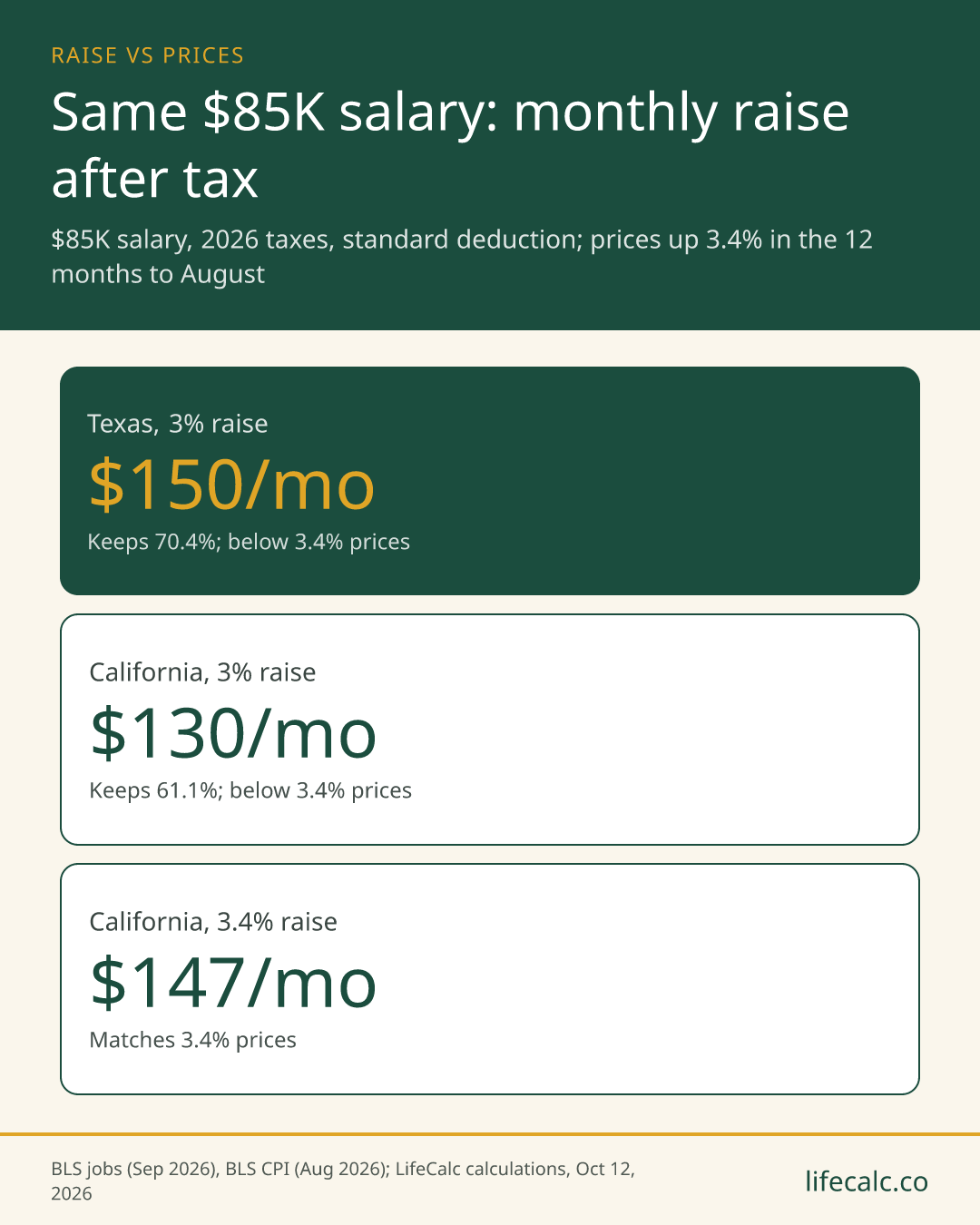
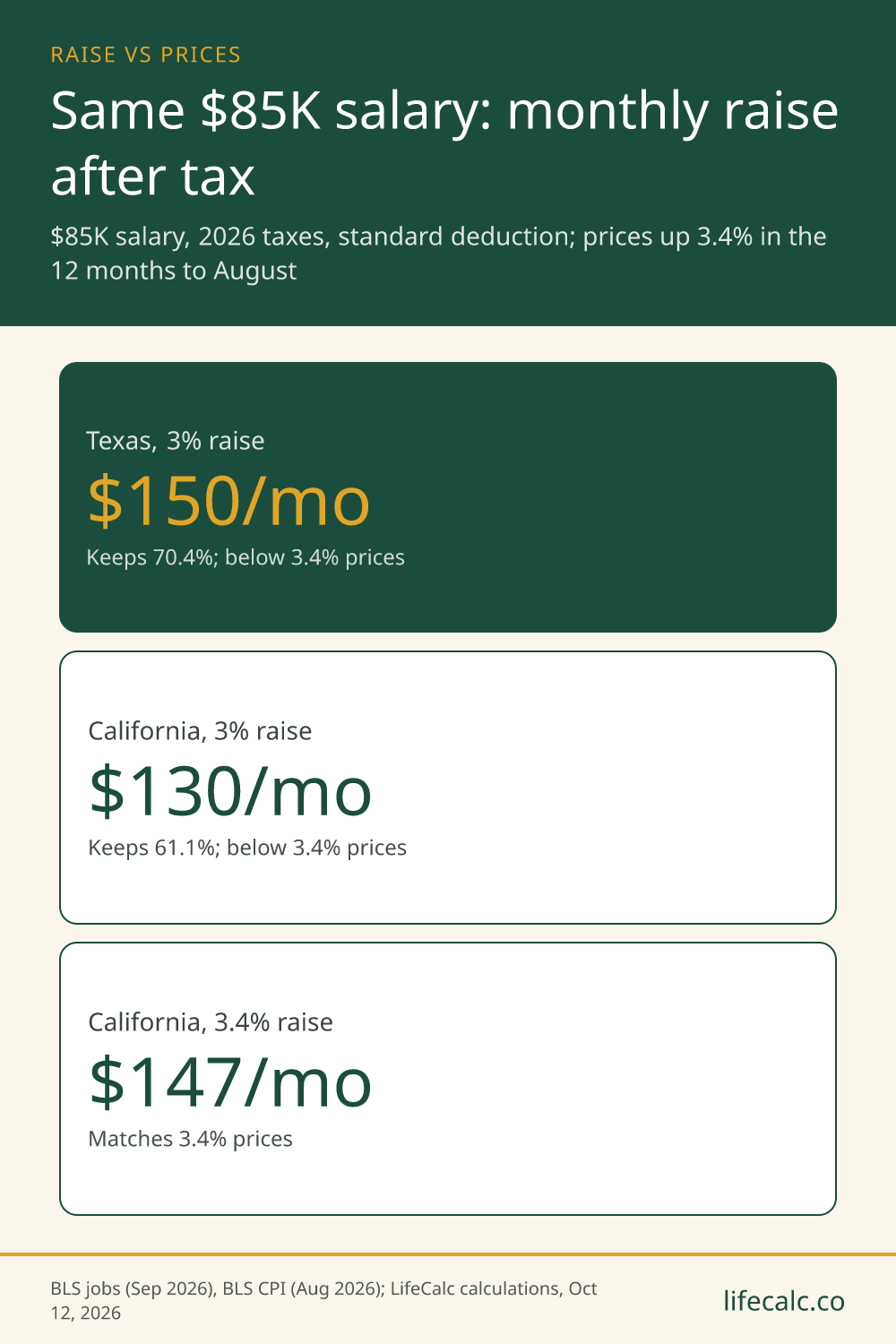
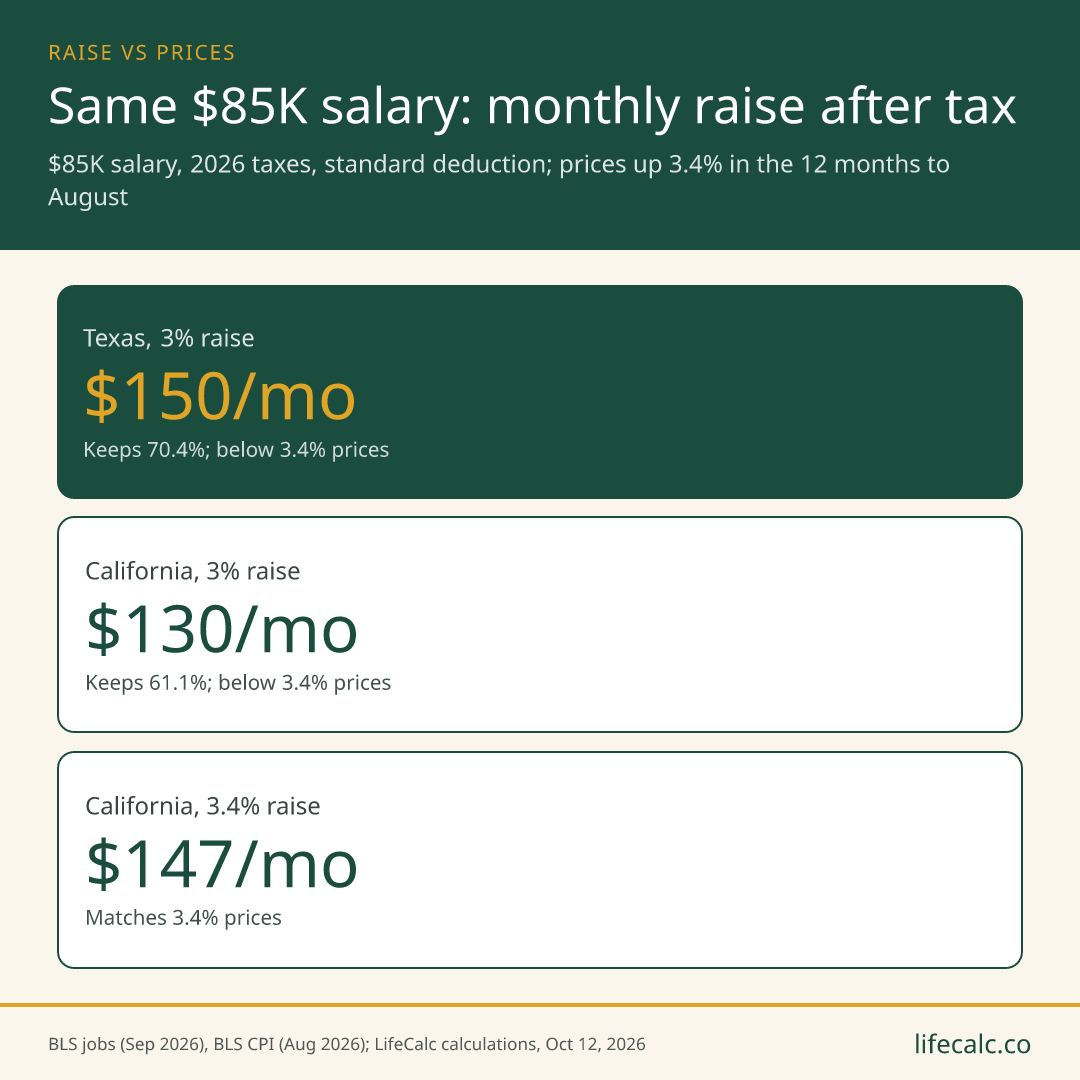
Average hourly earnings rose 3.0% while consumer prices rose 3.4%, so a 3% offer trails the latest price figure. On an $85K salary, a 3% raise adds $150 a month after tax in Texas and $130 in California, and a 3.4% raise in California would add $147.
Average hourly earnings rose 3.0 percent over 12 months to $37.81 in September 2026, while consumer prices rose 3.4% over the 12 months to August 2026. If you are offered a 3% raise, it is 0.4 points below that price increase, so the offer would leave your pay buying a little less than before.
Two caveats. The wage figure is for September and the price figure is for August, so they are not a perfect match. And average hourly earnings measure what all workers are paid on average, not the size of the raise any one person gets, so your own offer and your own costs may differ. The next CPI release, covering September data, is scheduled for October 14.
The same $85K salary keeps $150 a month in Texas and $130 in California
A raise is taxed at your top rates, so you keep only part of it. The figures here use federal income tax, Social Security and Medicare (FICA), and state income tax for the 2026 tax year, with the standard deduction and no other deductions or credits. Local, sales and property taxes are not included.
Holding salary and raise size fixed isolates the effect of the state. Here is an $85,000 salary:
| Scenario | Gross raise | Net raise per year | Net raise per month | Share kept |
|---|
| Texas, 3% raise | $2,550 | $1,794 | $150 | 70.4% |
| California, 3% raise | $2,550 | $1,557 | $130 | 61.1% |
| California, 3.4% raise | $2,890 | $1,765 | $147 | 61.1% |
Both workers get the same headline raise. The take-home difference comes from the state tax system, which is why an offer is best judged in net dollars as well as percentages.
Matching 3.4% in California is worth $340 more gross and $208 more a year after tax
If an $85,000 salary does not change while prices rise 3.4%, it is worth $82,205 in buying power, a loss of $2,795. Moving the California offer from 3% to 3.4% adds $340 to the gross raise. After tax, that is $208 more a year, or $17 more a month ($147 instead of $130).
Three different workers, three break-even asks
These three workers differ in salary, state and offer, so compare each one to its own break-even, not to each other. The break-even column is the raise that matches a 3.4% price rise.
| Worker | Offer | Net per month at offer | Raise at 3.4% | Net per month at 3.4% |
|---|
| $55K, Texas | 3% | $111 | $1,870 gross | $125 |
| $85K, California | 3% | $130 | $2,890 gross | $147 |
| $120K, New York | 4% | $253 | $4,080 gross | $215 |
The Texas worker's 3% offer is $1,650 gross and $1,326 net a year, and a 3.4% raise would be $1,503 net a year. The New York worker's 4% offer is $4,800 gross and $3,034 net a year, which is more than the $2,585 net a year a 3.4% raise would bring. So a 4% offer beats the latest price figure, while 3% does not. Flat pay at 3.4% would lose $1,809 of buying power on $55,000 and $3,946 on $120,000.
What would change the answer
- Your own costs. The 3.4% is a national average over the 12 months to August. If your rent, insurance or groceries rose faster, the gap is wider. If they rose slower, it is narrower.
- Future prices. The 3.4% describes the past year. It does not tell you what prices will do over the next year, so it is a reference point, not a target.
- Your state. The Texas and California rows above show that the same raise lands differently in take-home pay.
What to say in the negotiation
A raise of 3.4% would match the latest 12-month CPI, so it is a reasonable floor to cite if keeping your buying power is the goal. If you want a real gain, the number has to be above it. You can point to two facts: average wages rose 3.0% while prices rose 3.4%, and a 3% offer is below the price figure.
If the employer cannot move base salary, these are the options to ask about, and what each one does differently:
- A higher base later. Ask for a dated review in a few months. Base pay is the number future raises are calculated from.
- A one-time bonus. It is taxed like wages but does not raise the base that later raises build on.
- Employer retirement match. It does not show up in your paycheck, so it helps only if you were already saving enough to claim it.
- Paid time off or a stipend. Extra days off do not add cash, while a stipend does but may not count toward future raises.
To see what an offer adds to your paycheck in your state, use the paycheck calculator. To weigh a new job against your current one, try the job offer tool. To see how price rises erode a salary, use the inflation calculator.