Quick Answer
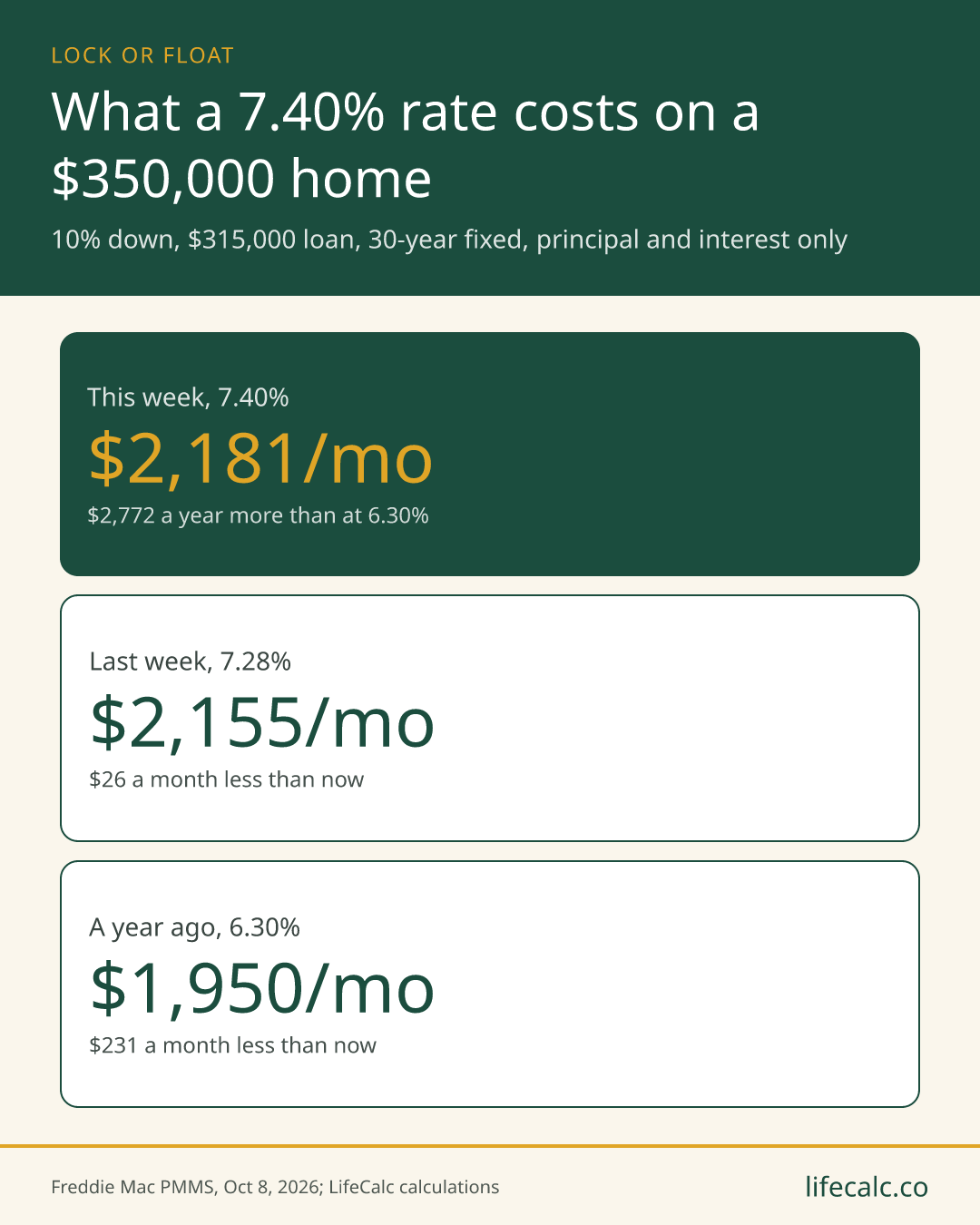
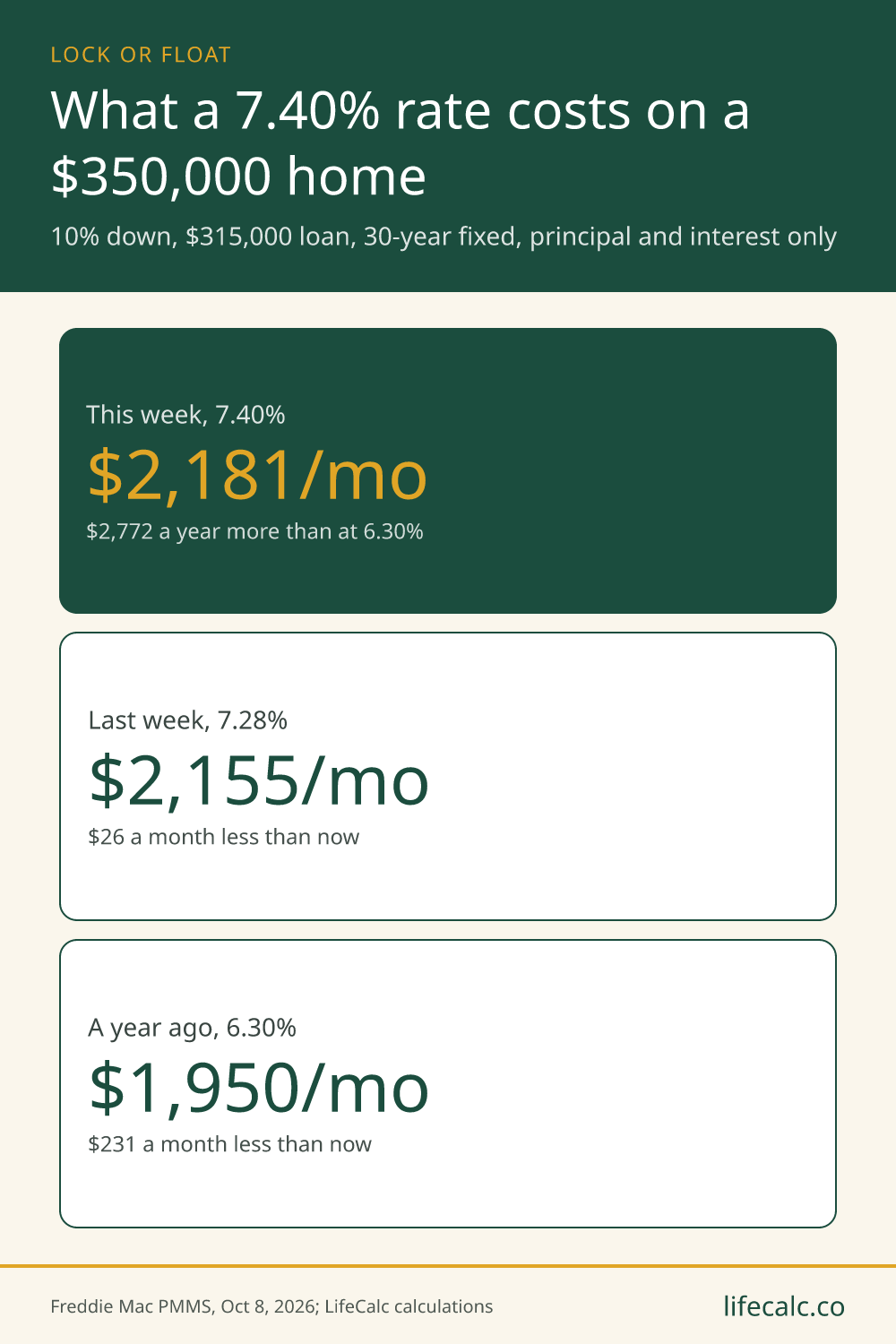
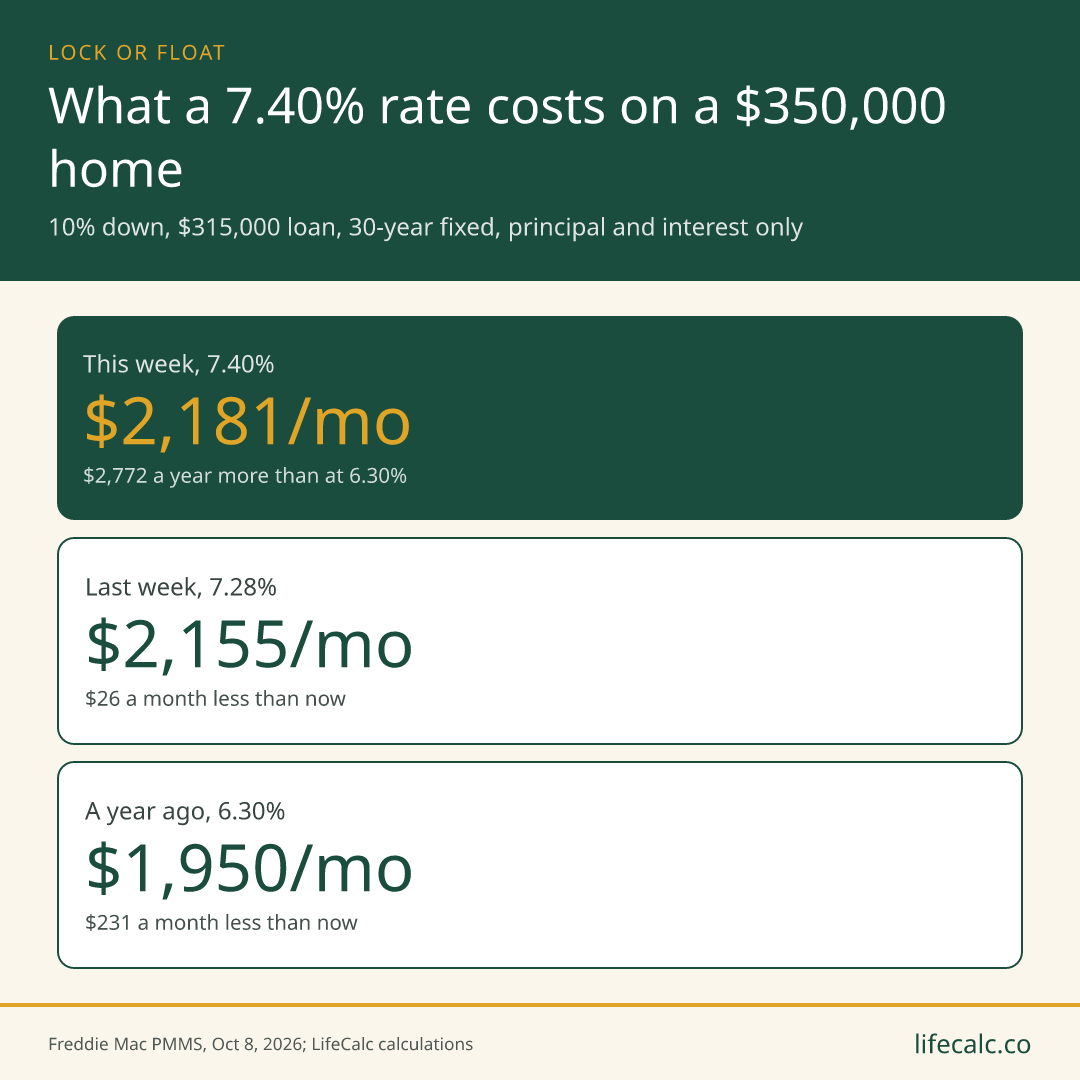
The 30-year rate rose to 7.40%, which adds $26 a month on a $350,000 home with 10% down versus last week, and $294 a month on a $500,000 home with 20% down versus a year ago. A 15-year loan on $315,000 raises the payment by $721 a month at the same 7.40% rate and cuts interest by $262,800.
Freddie Mac's 30-year fixed mortgage rate averaged 7.40% in the week ending Oct. 8, up from 7.28% the week before and 6.30% a year ago. The week's move is small in dollars; the year's move is what changes how much house a budget buys.
A rate lock is a lender's promise to hold your quoted rate for a set period while your loan closes. A float-down is an add-on that lets you take a lower rate if the market rate drops before closing. Unless stated, every payment below is principal and interest only on a 30-year fixed loan, with no property tax, insurance, mortgage insurance or HOA dues.
One week costs $26 or $33 a month; the year costs $231 or $294
Two buyers, each shown with the weekly move (7.28% to 7.40%) and the yearly move (6.30% to 7.40%):
| Buyer | Rate move | Payment before | Payment after | Monthly difference | Lifetime interest difference |
|---|
| $350,000 home, 10% down ($315,000 loan) | 7.28% to 7.40% | $2,155 | $2,181 | $26 | $9,360 |
| $350,000 home, 10% down ($315,000 loan) | 6.30% to 7.40% | $1,950 | $2,181 | $231 | $83,160 |
| $500,000 home, 20% down ($400,000 loan) | 7.28% to 7.40% | $2,737 | $2,770 | $33 | $11,880 |
| $500,000 home, 20% down ($400,000 loan) | 6.30% to 7.40% | $2,476 | $2,770 | $294 | $105,840 |
Annually, the week's move is $312 for the first buyer and $396 for the second. The year's move is $2,772 and $3,528. Lifetime interest assumes each loan runs the full 30 years.
Lock or float: what each choice puts at stake in dollars
Floating means leaving your rate open and accepting whatever it is at closing. The table shows the size of what is at stake, not which way it goes. Nothing here predicts where rates head next.
- The $350,000 buyer closing in 30 days. A lock covers the whole window. A move the size of last week's is worth $26 a month on this loan. A move the size of the past year's is worth $231 a month. If your payment at 7.40% is already near your ceiling, the lock removes the chance that closing day brings a payment you cannot carry. If there is room in the budget, the weekly difference alone is small.
- The $500,000 buyer still house-hunting. The same weekly move is $33 a month here, and the yearly move is $294. The bigger risk is timing: a short lock can run out before you have a contract. If a longer lock or a float-down carries a fee, compare that fee with these monthly figures over the years you expect to hold the loan. Fees vary by lender, so get them in writing.
The numbers do not pick one answer for both buyers. They show that a lock is worth most when the payment is close to a limit, and that a float-down is worth asking about when the closing date is uncertain.
On a $100,000 income, 7.40% lowers the price you can afford by $49,959
The third buyer is deciding whether to cut the price target. This uses a 28% guideline: monthly housing cost at or under 28% of gross income, which is $2,333 a month on $100,000. Here that 28% is applied to principal and interest alone, on a 30-year loan with 20% down. Many lenders apply a similar ratio to the full housing payment, including property tax and insurance, so the prices below are optimistic. Taxes, insurance and other debts would lower them.
| Rate | Max loan | Max price | Down payment |
|---|
| 6.30% | $376,969 | $471,211 | $94,242 |
| 7.40% | $337,002 | $421,252 | $84,250 |
The same $2,333 budget buys a home priced $49,959 lower at 7.40%. If the price target has not moved, the payment on it has. To see where a given payment sits, $2,181 needs a gross income of $93,471 under the same guideline, and $2,770 needs $118,714.
A 15-year loan: $721 more a month at the same rate, $262,800 less interest
Freddie Mac put the 15-year fixed at 6.73%. Comparing it with the 30-year loan mixes two effects, a shorter term and a lower rate, so here they are separately on the $315,000 loan, held to the end of the term:
| Loan | Monthly payment | Total interest |
|---|
| 30-year at 7.40% | $2,181 | $470,160 |
| 15-year at 7.40% | $2,902 | $207,360 |
| 15-year at 6.73% | $2,784 | $186,120 |
Shortening the term alone, at 7.40%, adds $721 a month ($8,652 a year) and cuts interest by $262,800. At 6.73%, the 15-year payment is $603 above the 30-year payment ($7,236 a year) and interest is $284,040 lower.
The shorter loan also lowers the price a $100,000 income supports. At 6.73% over 15 years, with 20% down and the same 28% guideline, the maximum price is $330,014, with $66,003 down. That compares with $421,252 on the 30-year loan at 7.40%.
A flexible alternative is a 30-year loan with an extra $300 a month toward principal from the first payment. On the $315,000 loan at 7.40%, the payment is $2,481, payoff comes in 20.8 years, and interest falls by $168,663. You can stop the extra in a tight month, which a 15-year loan does not allow.
What would change the answer
- How close the payment is to your ceiling. If the 7.40% payment is near your limit, the lock's certainty matters more than the small weekly difference.
- Monthly cash flow versus total interest. If cash flow matters more, the numbers point to the 30-year loan, with optional extra payments. If total interest matters more, they point to the 15-year loan, provided you can carry the higher payment.
- Your price target and down payment. A larger down payment shrinks the loan and so the payment at any rate. The figures in this article do not isolate that effect, so test your own amounts in the mortgage calculator. If the budget is fixed, the price that fits at 7.40% is the $421,252 figure, not the $471,211 one.
To test your own income, down payment and rate, use the home affordability calculator, and add your estimated property tax and insurance, since the figures above leave them out.