Quick Answer
Energy prices rose 20.4% while core inflation was 2.6%, so the squeeze sits in utilities and fuel. Applied to year-ago spending, that is $71 a month on $350 and $184 a month on $900, while 3.7% overall adds $240 to a $6,500 budget.
Consumer prices rose 3.7% over the 12 months ending September 2026, and the energy index rose 20.4%, according to yesterday's Bureau of Labor Statistics release. The number that matters for a budget is the gap: core prices (everything except food and energy) rose 2.6%, shelter 3.2% and food 2.5%.
So the pressure is not spread evenly. A household with a large energy and fuel bill faces a different reset than one that spends mostly on rent and groceries. Below are three illustrative households and the math for each.
How to read the dollar figures: each amount is treated as year-ago spending
Each calculation applies the 12-month price change to the whole amount shown. That treats the amount as what the household spent a year ago. If $350, $900 or $6,500 is what you pay today, the increase is already inside your bills, and the figures show how much of your current spending it accounts for rather than a new cost still coming.
The energy jump adds $71 to $184 a month, and 3.7% overall adds $240 to a $6,500 budget
| Household and category | Spending | Price change applied | Added per month | Added per year |
|---|
| Renter, gas and utilities | $350 | Energy +20.4% | $71 | $857 |
| Family of four, energy and fuel | $900 | Energy +20.4% | $184 | $2,203 |
| Family of four, groceries | $1,100 | Food +2.5% | $28 | $330 |
| Sample total budget | $6,500 | All items +3.7% | $240 | $2,886 |
| Retired couple, fixed budget | $4,000 | All items +3.7% | $148 | $1,776 |
The $6,500 row is one example budget, not a typical household. The family's $900 of energy and fuel is 13.8% of a $6,500 budget, so the $184 and the $240 apply different rates to overlapping money and should not be added together.
A renter's $350 becomes $421 only if all of it is energy
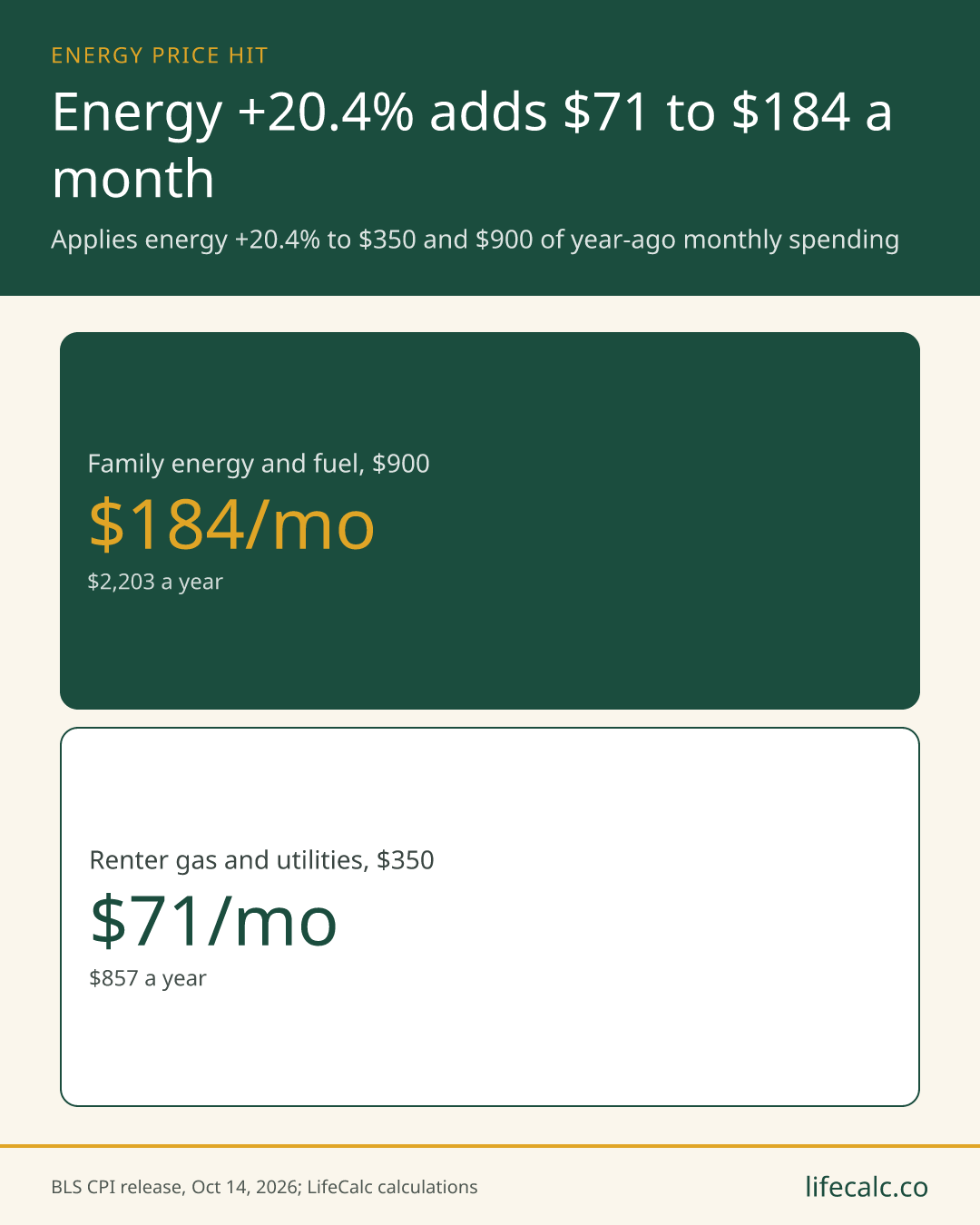
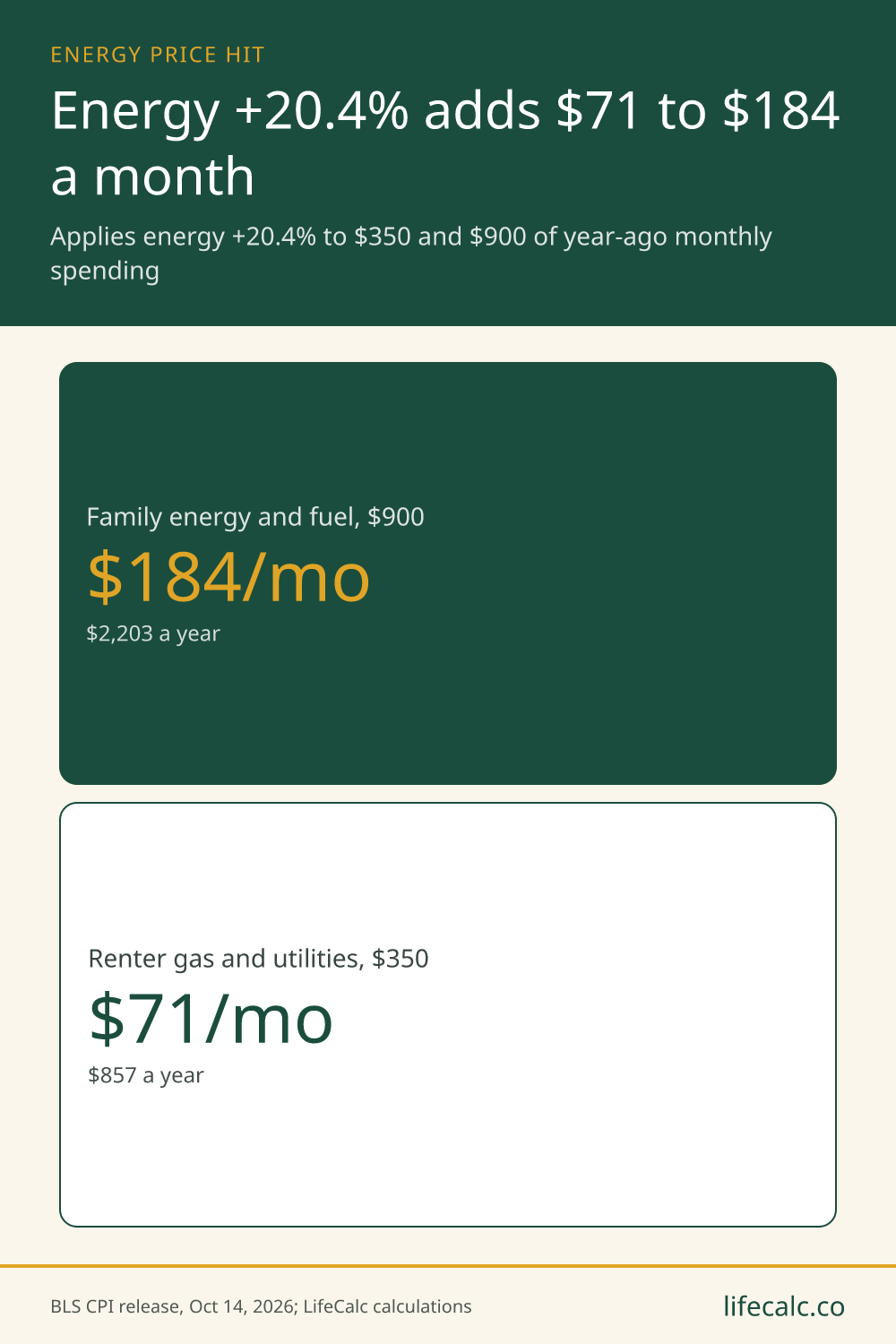
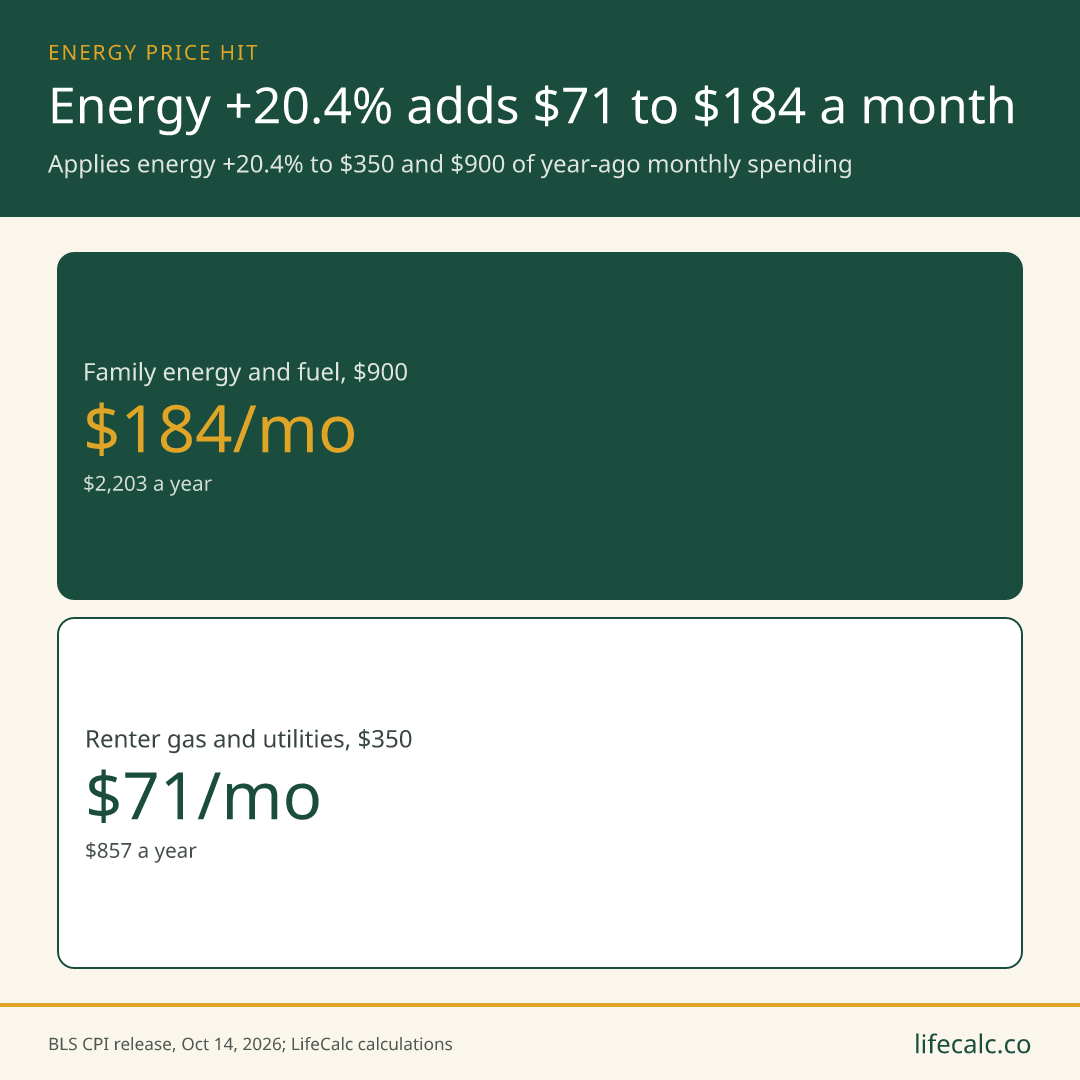
A 20.4% rise turns $350 a month into $421. That is $71 more a month, or $857 over a year. The catch is the label. "Gas and utilities" can include water, sewer, trash and internet, which are not part of the energy index. If only part of your $350 is gas and electricity, apply 20.4% to that part alone and your increase will be smaller than $71. If your lease includes some utilities, only the bills you pay directly count.
For a family of four, energy adds $184 a month and groceries $28
At 20.4%, $900 of energy and fuel becomes $1,084, an extra $184 a month or $2,203 a year. The $1,100 grocery bill at the 2.5% food rate becomes $1,128: $28 more a month, $330 a year.
In this example the energy line moved by far more dollars than the grocery line. If your goal is to offset the increase with the least change to what you buy, the energy and fuel line is where the dollars are in this household. A different mix, such as a family that drives little or has a large grocery bill, would produce a different answer, which is why your own line items matter more than this example.
If prices rise 3.7% a year for three years, a fixed $4,000 needs $4,461
This assumes a constant 3.7% each year. That is an assumption for illustration, not a forecast. Under it, a fixed $4,000 a month buys what $3,587 buys today after three years. That is $413 of lost buying power, or 10.3%. To keep today's purchasing power, the couple would need $4,461 a month, an 11.52% increase over the three years.
If inflation runs lower than 3.7%, the loss shrinks. If their spending leans toward energy, which rose faster than the overall rate over the past year, their own loss could be larger. The inflation calculator lets you test other rates.
The release does not say whether the energy jump will last
The figures above come from a 12-month comparison, so they show where prices are against a year ago. The facts in this article do not say what is driving the energy increase, and they do not show whether it will persist, so this piece makes no call on that. The September reading for all items was also +0.6% for the month, seasonally adjusted, which is one month of data.
That uncertainty changes how you might build the reset. If you treat the energy increase as lasting, the trim or the extra income has to be permanent. If you treat it as temporary, a short-term cushion from savings may fit better than rewriting the whole budget. The next readings help you choose: the Bureau of Economic Analysis publishes September personal income and outlays, including PCE (another price measure), on October 29, the same day as the Federal Reserve's rate decision. This article does not predict either result. They are simply more data points before you lock in a permanent change.
Trim or earn: a 3.7% raise on $90,000 nets $215 a month
Earning more means taxes take a share. For a married couple in Ohio earning $90,000, a 3.7% raise brings the salary to $93,330, a gross raise of $3,330. After federal income tax, FICA and Ohio income tax, they keep $2,584 a year, or $215 a month, which is 77.6% of the raise. This uses the 2026 standard deduction and no other deductions or credits, and it leaves out local, sales and property taxes.
The takeaway is the share kept: of each raise dollar in this example, 77.6% reaches the paycheck. This salary is unrelated to the sample budgets above, so it is not a match for any one of them. To compare a raise with your own cost increase, put your salary into the paycheck calculator and set the net result beside the increase on your own bills.
A reset checklist built on your own numbers
- List your energy and fuel spending first. If you want to see your own monthly hit, apply 20.4% to the gas, electric and fuel portion only. The budget calculator shows where that sits in your total.
- Compare it with your other lines. Food rose 2.5% and shelter 3.2%, both below energy. If your energy share is small, the across-the-board 3.7% may describe your budget better.
- Check what a raise would keep. If your cost increase is larger than what you can trim, the after-tax example shows that 77.6% of a raise reached the paycheck in that case.
- If your income is fixed, use the three-year number. The $413 loss is what happens at a steady 3.7% with no change in income.
- Decide what is permanent. Match permanent cuts to a lasting increase and a savings cushion to a temporary one, then recheck after the October 29 releases and the next CPI.