Quick Answer
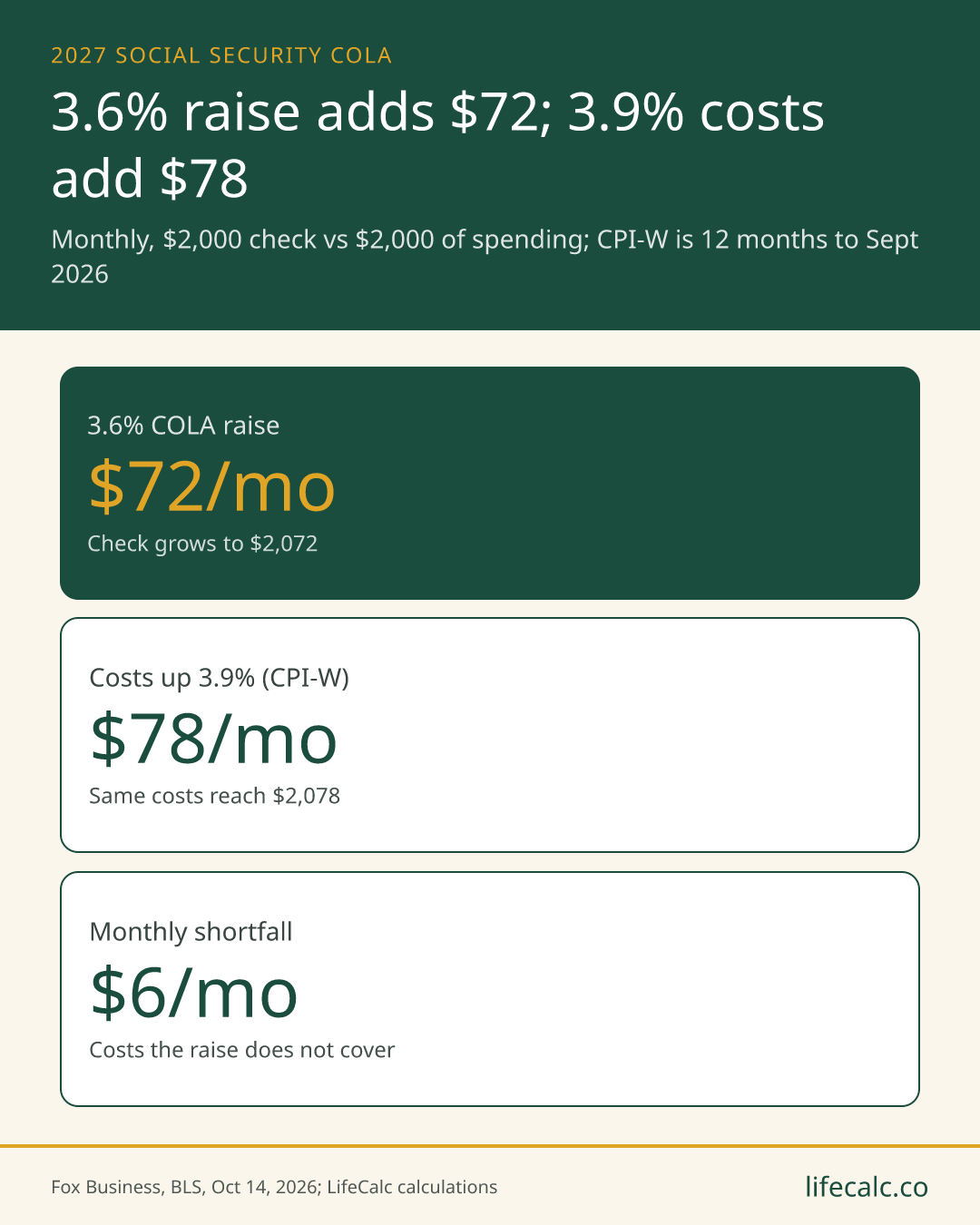
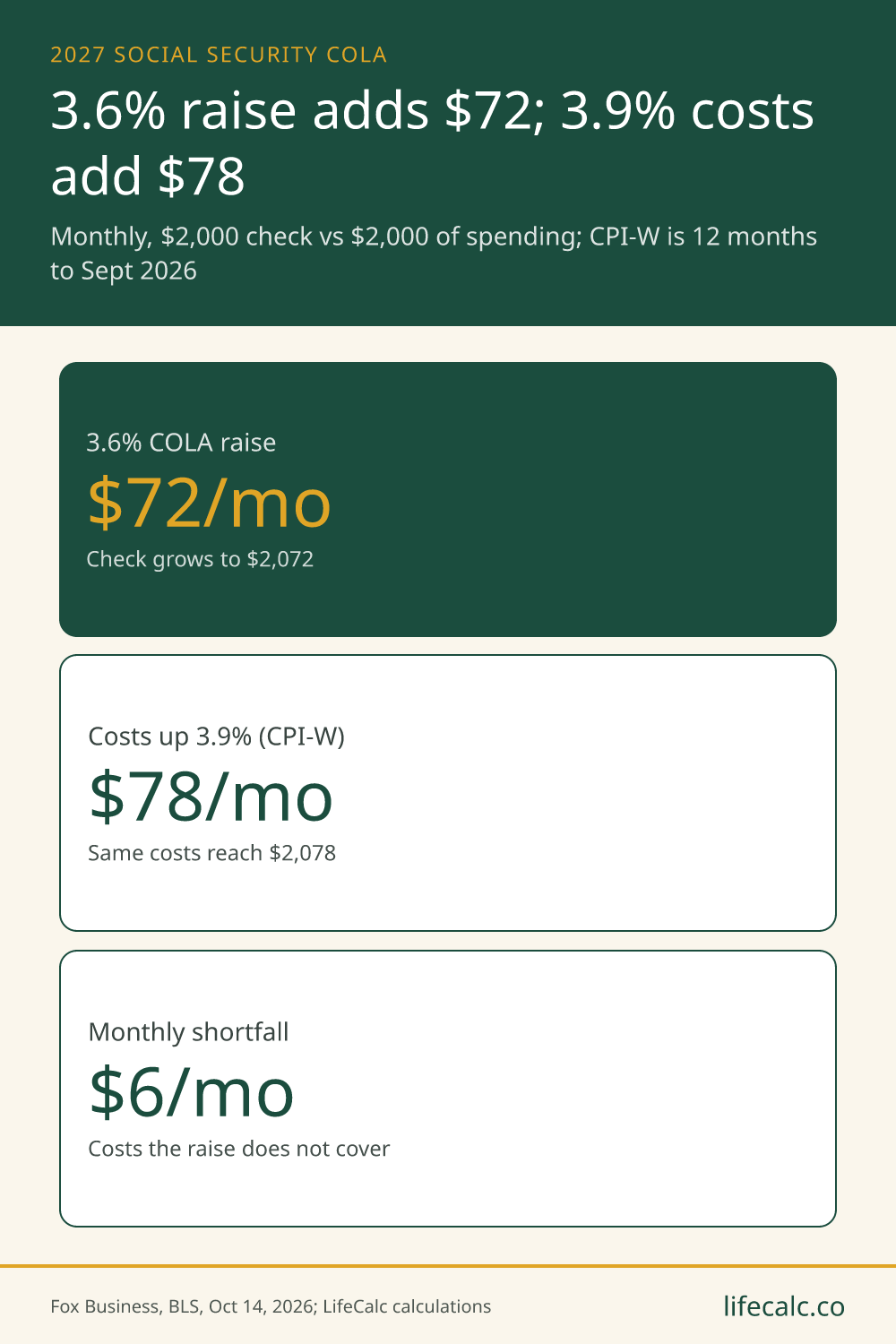
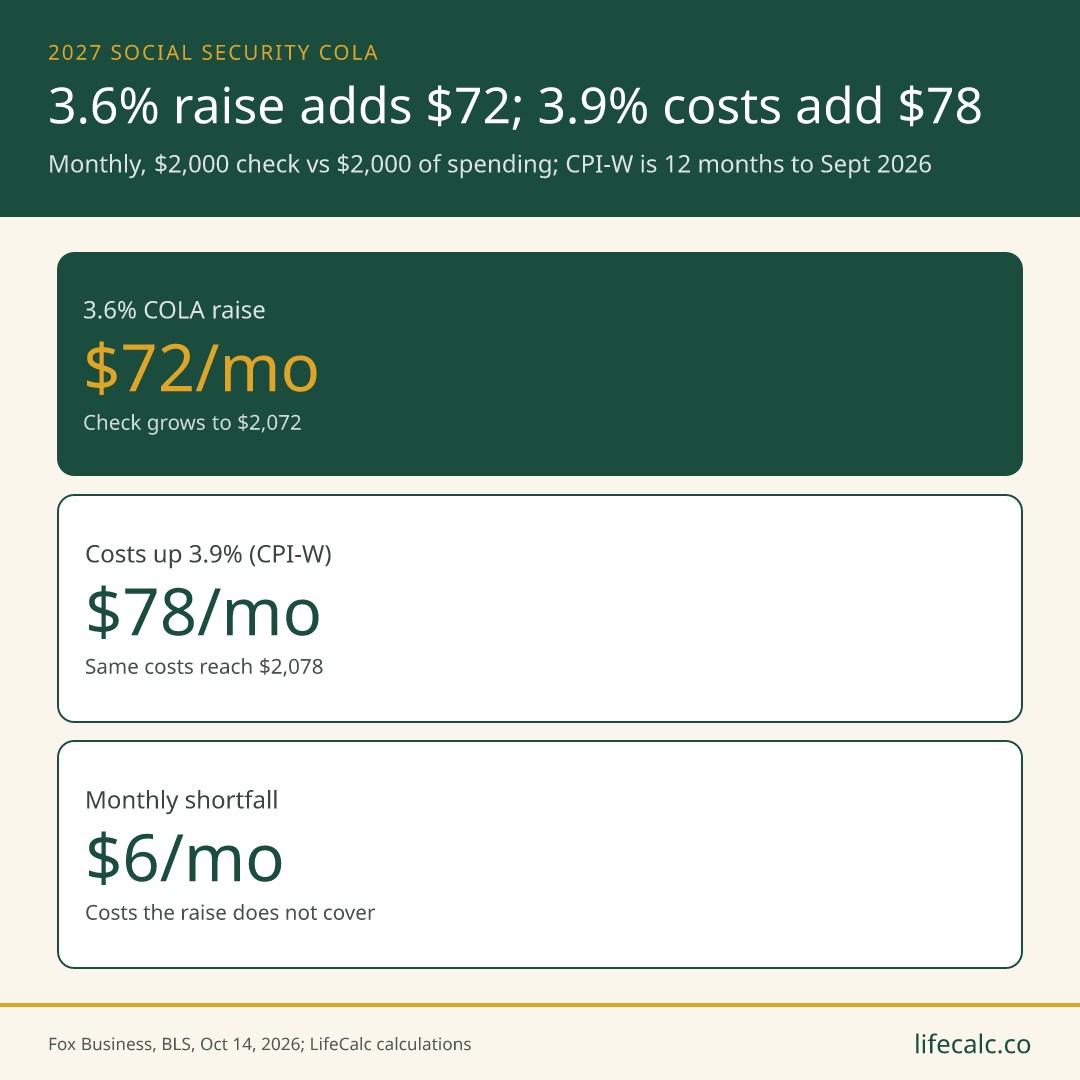
A 3.6% raise adds $72 a month to a $2,000 Social Security check, while the same $2,000 of costs rising 3.9% would add $78, a $6 monthly gap. A fuel-heavy budget can widen that gap if gas rises faster than the average.
Social Security announced a 3.6% cost-of-living adjustment (COLA) for 2027, about $75 a month on average for retirees. On a $2,000 check that is $72 a month, while the 3.9% rise in CPI-W over the 12 months ending September 2026 would add $78 to $2,000 of costs.
CPI-W is a government price index that tracks what urban wage earners and clerical workers pay. One caution on comparing the two numbers: the COLA applies to checks in 2027, while the 3.9% covers the 12 months to September 2026. They measure different windows, so the comparison below shows how the raise stacks up against recent prices, not against what 2027 prices will do.
A 3.6% raise adds $54, $72 or $101 a month, depending on your check
The raise is a flat percentage of your current benefit, so it grows with the check. The last column shows what the same spending would cost if prices rose 3.9%.
| Monthly benefit | Raise at 3.6% | New check | Added per year | Same spending at 3.9% |
|---|
| $1,500 | $54 | $1,554 | $648 | $1,558 |
| $2,000 | $72 | $2,072 | $864 | $2,078 |
| $2,800 | $101 | $2,901 | $1,210 | $2,909 |
The $1,500 and $2,000 checks get less than the $75 average, and the $2,800 check gets more. The $2,000 raise is $3 below the average.
Against 3.9% prices, a $2,000 check falls $6 a month short
If the $2,000 you spend each month rises 3.9%, it costs $2,078. Your check rises to $2,072. That leaves $6 a month, or $72 a year, of higher costs the raise does not cover. The raise trails prices by 0.3 points.
To see how sensitive that is, try a milder scenario, not a reported figure: prices rise 3.7% instead. Then $2,000 of spending becomes $2,074, and the raise trails by 0.1 points instead of 0.3. The gap shrinks but does not disappear.
Over five years, a 3.6% raise against 3.7% prices keeps a $2,000 check near $1,990
This is an illustration, not a forecast. Assume the check gets a 3.6% raise every year for five years and prices rise 3.7% every year. Measured in today's dollars, the $2,000 check is then worth about $1,990, a loss of $10, or 0.5%.
The raise is what protects that value. A check with no raise at all, facing the same 3.7% a year, is worth $1,668 after five years, a loss of $332, or 16.6%. The risk to a retiree is therefore not this year's small gap on its own, but years in which prices outrun the raise by more than 0.1 points.
A fuel-heavy budget can use up part of the raise
The COLA reflects an average basket of goods. If you drive a lot, your basket leans toward gas. This example is hypothetical, with round numbers chosen only to show the mechanics, and this article has no gas price data: suppose you spend $300 a month on gas and that rises 10%. It becomes $330, which is $30 more a month and $360 more a year. Against the $72 raise on a $2,000 check, that one category would take $30 before any other cost moves.
If your gas spending rises less than the average, the picture reverses.
What would change the answer
- Your spending mix. Heavy fuel, medical or housing costs can rise faster or slower than 3.9%.
- The size of your check. The percentage gap is the same for everyone, but the dollar raise grows with the check, as the table shows.
- Which price figure you compare with. Against the 3.7% scenario the raise is 0.1 points short. Against the reported 3.9% it is 0.3 points short.
How to run it on your own check
Multiply your current benefit by 3.6% for your raise, or use the table if you are near one of the three examples. These dollar amounts are the raise before any deductions, such as a Medicare premium taken from your payment, so your benefit notice shows the net amount. Then list your biggest monthly costs and put a rise on each that matches your own bills. The budget calculator lays out those categories, and the inflation calculator shows what a steady price rise does to a fixed amount over time.
If your own costs rise faster than 3.6%, the numbers point to a shortfall to cover from savings or by trimming a category. If they rise slower, the raise leaves room.